
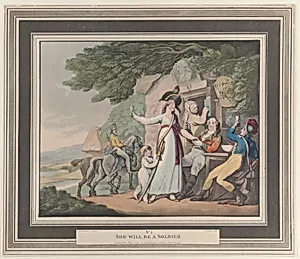
No. 1: She Will Be A Soldier
Medium
Etching
Dimensions
Sheet: 13 1/4 × 15 1/2 in. (33.6 × 39.4 cm)
Classification
Prints
Department
Drawings and Prints
Museum
Metropolitan Museum of Art, New York, NY
Credit
The Elisha Whittelsey Collection, The Elisha Whittelsey Fund, 1959
Accession Number
59.533.517
Rights
Public Domain
Tags
Art Historical Context
Created in 1798 by the collaborative talents of publisher Rudolph Ackermann, etcher Heinrich Joseph Schütz and caricaturist Thomas Rowlandson *No. 1: She Will Be A Soldier* is a hand-colored etching that captures the lively spirit of late 18th-century British satire. Measuring 13¼ × 15½ inches, this print from the Metropolitan Museum of Art's Elisha Whittelsey Collection exemplifies the era's booming market for affordable, witty imagery, often sold in Ackermann's famed Repository of Arts. The title hints at a humorous scene blending soldiers, children, men, women, and revelry around drinking—hallmarks of Rowlandson's style. Known for his exaggerated, bawdy depictions of everyday life, Rowlandson skewers social norms, here perhaps poking fun at gender roles amid Britain's military fervor during the Napoleonic Wars' early stirrings. Etching, with its precise lines incised by acid on a metal plate, allowed for sharp details and mass production, making such commentary accessible to a wide audience beyond the elite. This work reflects etching's role in democratizing art, turning taverns and barracks into stages for cultural critique. Visitors will delight in its cheeky energy, a window into Regency England's boisterous underbelly.
About the Artist
Rudolph Ackermann, London|Heinrich Joseph Schütz|Thomas Rowlandson · 1794–1832
**Rudolph Ackermann (1764–1834)** was a pivotal Anglo-German publisher, printseller, and entrepreneur whose London-based business shaped Regency-era visual culture through innovative printmaking and illustrated publications. Born in Stollberg, Saxony, he trained as a saddler and coach-builder before moving to London around 1787. He initially worked in carriage design and related trades, later esta...