
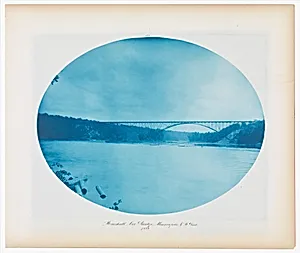
No. 181. Marshall Ave. Bridge, Minneapolis & St. Paul
1889
Medium
Cyanotype
Dimensions
Sheet: 14 1/2 × 17 3/16 in. (36.8 × 43.7 cm)
Classification
Photographs
Department
Photographs
Museum
Metropolitan Museum of Art, New York, NY
Credit
Gift of Charles Wehrenberg and Sally Larsen, 2014
Accession Number
2014.715.11
Rights
Public Domain
Tags
Art Historical Context
Henry P. Bosse’s *No. 181. Marshall Ave. Bridge, Minneapolis & St. Paul* captures a vital moment in American infrastructure at the close of the nineteenth century. Created in 1889 as a cyanotype—a photographic process prized for its deep Prussian-blue tones and sharp detail—the large sheet records the sturdy iron structure spanning the Mississippi River between the Twin Cities. At a time when railroads and urban growth demanded reliable crossings, such bridges symbolized both engineering ambition and the rapid transformation of the American landscape. The choice of cyanotype was especially fitting for documenting functional architecture. Originally developed for reproducing technical drawings, the medium offered durability and clarity that suited Bosse’s methodical approach to recording bridges, waterways, and surrounding terrain. The resulting image balances precise architectural lines with the soft atmospheric qualities of the river setting, inviting viewers to consider how photography could serve both scientific record and aesthetic appreciation. Today housed in the Metropolitan Museum of Art’s Department of Photographs, this work reminds us that the everyday structures of the industrial era were themselves worthy of artistic attention. Its generous scale and distinctive blue palette continue to draw modern audiences into a dialogue between progress, place, and the early history of photography.
About the Artist
Henry P. Bosse · 1844–1893
Henry Peter Bosse was born in 1844 in Sonneberg, Prussia (now Germany), and immigrated to the United States around 1870. He settled in the Midwest and joined the U.S. Army Corps of Engineers in 1874 as a draftsman. By the mid-1880s he had risen to chief draftsman in the Rock Island, Illinois, district, where he remained for the rest of his career. His dual expertise in engineering and visual docum...