
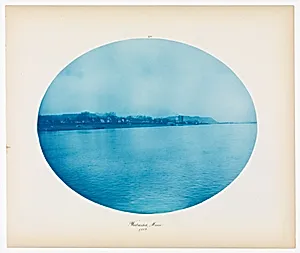
No. 69. Wabasha, Minnesota
1889
Medium
Cyanotype
Dimensions
Sheet: 14 1/2 × 17 3/16 in. (36.8 × 43.7 cm)
Classification
Photographs
Department
Photographs
Museum
Metropolitan Museum of Art, New York, NY
Credit
Gift of Charles Wehrenberg and Sally Larsen, 2014
Accession Number
2014.715.4
Rights
Public Domain
Tags
Art Historical Context
Henry P. Bosse's *No. 69. Wabasha, Minnesota*1889) captures a serene landscape along the Mississippi River in this small Minnesota town, part of the artist's meticulous documentation of America's heartland waterways. As a civil engineer and photographer active in the late 19th century, Bosse produced numerous views of the upper Mississippi, blending scientific precision with artistic vision. This numbered print hints at his systematic approach, likely created during surveys for the U.S. Army Corps of Engineers, offering visitors a window into the untamed beauty of the Midwest during westward expansion. The work's cyanotype medium— a pioneering photographic process invented in 1842—produces its signature Prussian blue tones through exposure to sunlight and ferric ammonium citrate. Affordable and light-sensitive, cyanotypes were ideal for field photography and reproducible prints, revolutionizing documentation of architecture, botany, and landscapes. Bosse's use here emphasizes dramatic contrasts and expansive compositions, turning technical surveys into poetic evocations of nature. Today, this 14 1/2 × 17 3/16 in. sheet, gifted to The Metropolitan Museum of Art in 2014, highlights the artistic potential of early photography. It invites reflection on how 19th-century innovators like Bosse transformed everyday engineering tasks into enduring visual records of America's evolving geography.
About the Artist
Henry P. Bosse · 1844–1893
Henry Peter Bosse was born in 1844 in Sonneberg, Prussia (now Germany), and immigrated to the United States around 1870. He settled in the Midwest and joined the U.S. Army Corps of Engineers in 1874 as a draftsman. By the mid-1880s he had risen to chief draftsman in the Rock Island, Illinois, district, where he remained for the rest of his career. His dual expertise in engineering and visual docum...