
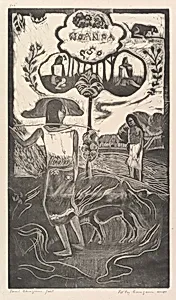
Noa Noa
1893–94
Medium
Woodcut on China paper
Dimensions
14 x 8 1/16 in. (35.6 x 20.5 cm): block 16 7/8 x 10 1/4 in. (42.9 x 26 cm): paper
Classification
Prints
Department
Drawings and Prints
Museum
Metropolitan Museum of Art, New York, NY
Credit
Rogers Fund, 1921
Accession Number
21.38.10
Rights
Public Domain
Tags
Art Historical Context
**Noa Noa**, a striking woodcut created by Paul Gauguin 1893 and 1894, captures the artist's fascination with Tahitian life following his transformative first journey to the South Pacific in 1891–93. Printed on delicate China paper, this intimate work measures about 14 x 8 inches at the block, showcasing Gauguin's experimental approach to printmaking. As part of his renowned *Noa Noa* suite—named after his Tahitian and meaning "sweet-scented" or "fragrant" in the local language—it reflects his escape from European civilization toward an idealized, primitive paradise. Gauguin, a Post-Impressionist pioneer of Symbolism and Primitivism, drew inspiration from Japanese ukiyo-e prints and Oceanic art, carving bold, rough-hewn lines into the woodblock himself for a raw, expressive quality. This medium allowed for textured, hand-pulled impressions that emphasized flattened forms and vibrant contrasts, departing from Western realism. Featuring human figures alongside animals, the print evokes exotic, harmonious scenes of daily life, blending sensuality and spirituality. Housed in the Metropolitan Museum of Art's Drawings and Prints department (acquired via Rogers Fund in 1921), *Noa Noa* exemplifies Gauguin's influence on modern art, bridging 19th-century experimentation with 20th-century abstraction and inspiring movements like Fauvism. Visitors are drawn to its evocative power, a window into the artist's mythic vision of Polynesia.
About the Artist
Paul Gauguin · 1848–1903
Paul Gauguin (1848-1903) was a French Post-Impressionist painter whose bold experiments with color, form, and subject matter made him one of the most influential figures in the transition from 19th-century art to modernism. His rejection of European civilization for the perceived authenticity of 'primitive' cultures established an archetype of artistic exile that continues to resonate. Gauguin's ...