
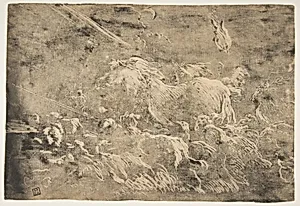
Noah and the animals entering the ark
Medium
Monotype
Dimensions
Sheet: 9 13/16 × 14 3/8 in. (25 × 36.5 cm)
Classification
Prints
Department
Drawings and Prints
Museum
Metropolitan Museum of Art, New York, NY
Credit
Harris Brisbane Dick Fund, 1936
Accession Number
36.55.1
Rights
Public Domain
Tags
Art Historical Context
Step into the dramatic world of Giovanni Benedetto Cast, known as Il Grechetto, with his captivating monotype *Noah and the Animals Entering the Ark* (1650–55). This Baroque master from Genoa, renowned for his lively depictions of animals and biblical narratives, draws us into the Genesis story of salvation amid the impending flood. Castiglione's fluid lines and dynamic composition capture the orderly procession of creatures—elephants, giraffes, and birds—boarding the ark, blending human drama with the natural world's wonder. What makes this work extraordinary is its medium: monotype, a technique Castiglione pioneered in the 1640s. Unlike traditional prints that allow multiple editions, a monotype involves painting ink directly onto a smooth plate and pressing it onto paper, yielding a unique, painterly image with rich tonal variations and spontaneous effects. Measuring just 9 13/16 × 14 3/8 inches, this intimate sheet from The Metropolitan Museum of Art's Drawings and Prints collection showcases his etching expertise adapted to this innovative method, bridging painting and printmaking. Created during Italy's vibrant 17th-century artistic ferment, the print reflects Counter-Reformation themes of divine providence, while Castiglione's menagerie highlights his lifelong fascination with animals, studied from life in royal stables. A rare survivor of his experimental prints, it invites visitors to marvel at one artist's bold fusion of faith, nature, and technique.
About the Artist
Giovanni Benedetto Castiglione (Il Grechetto) · 1609–1664
Giovanni Benedetto Castiglione, known as Il Grechetto, was baptized on March 23, 1609, in Genoa and died on May 5, 1664, in Mantua. Born into a large family, he collaborated closely with his brother Salvatore, an artist who shared his talents, and later taught his son Francesco, whose works were sometimes confused with his own. His parents placed him in the studio of Giovanni Battista Paggi, where...