
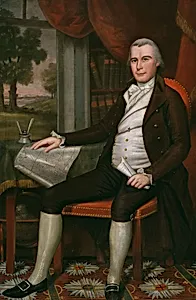
Noah Smith
1798
Medium
Oil on canvas
Dimensions
163.2 × 107.3 cm (64 1/4 × 42 1/4 in.)
Classification
painting
Department
Arts of the Americas
Museum
Art Institute of Chicago
Accession Number
2158
Rights
Public Domain
About this artwork
Ralph Earl garnered portrait commissions primarily from wealthy rural landowners in Connecticut, New York, and Vermont. A loyalist, Earl fled America for England during the Revolutionary War, developing his portrait style, in turn, by studying with Benjamin West (an American painter in London) and through contact with English artists. Returning in 1785, Earl painted this portrait of Noah Smith late in his career, having melded his British training with a simpler, linear style that appealed to hi...
Art Historical Context
Ralph Earl’s 1798 portrait of Noah Smith captures a moment of early American self-fashioning in the years following the Revolution. Painted in oil on canvas at a monumental scale, the work reflects the aspirations of the new republic’s emerging elite. Earl, an American-born artist who trained briefly in London, brought a direct, unadorned realism to his sitters that distinguished his work from the more theatrical British portrait tradition. The painting’s generous dimensions and formal pose underscore the cultural importance of portraiture in Federal-era America. Such large canvases were commissioned to convey status and legacy, often displayed in homes or public spaces as statements of civic virtue. Earl’s careful attention to fabric textures and composed demeanor reveals both the technical demands of oil painting and the sitter’s desire to project dignity and stability during a period of national formation. Housed in the Art Institute of Chicago’s Arts of the Americas collection, the portrait offers visitors a tangible connection to the individuals who shaped the young United States.
About the Artist
Ralph Earl · 1751–1801
Ralph Earl (1751–1801) was born on May 11 in Shrewsbury or Leicester, Massachusetts, the eldest of four children to Ralph Earle, a colonel in the Revolutionary army, and Phebe Whittemore Earl. Growing up amid farmers and craftsmen in Worcester County, Earl displayed prodigious talent as a self-taught artist, emulating the works of John Singleton Copley after observing his half-brother Henry Pelham...