
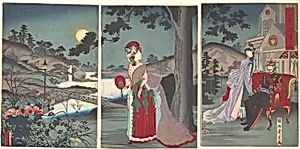
『高貴納涼ノ図』|Nobility in the Evening Cool (Koki nōryō no zu)
Medium
Triptych of woodblock prints; ink and color on paper
Dimensions
Image: 13 3/4 x 27 1/2 in. (34.9 x 69.9 cm)
Classification
Prints
Culture & Period
Japan · Meiji period (1868–1912)
Department
Asian Art
Museum
Metropolitan Museum of Art, New York, NY
Credit
Gift of Lincoln Kirstein, 1959
Accession Number
JP3338
Rights
Public Domain
Tags
Art Historical Context
In the tranquil glow of a summer evening, Yōshū (Hash) Chikanobu's *Nobility in the Evening* (1887) captures a moment of refined leisure among Japan's elite. This tript woodblock print, rendered in vibrant ink and color on paper unfolds a panoramic scene (13 3/4 x 27 1/2 in.) featuring elegant men and women beneath moonlit trees. The wide format invites viewers into an intimate outdoor gathering, evoking the traditional Japanese pursuit of *nōryō*—seeking respite from the heat. Created during the Meiji period (1868–1912), a time of rapid modernization and Western influence, Chikanobu's work exemplifies the enduring vitality of ukiyo-e woodblock printing. As a master of this collaborative art form—involving designers, carvers, printers, and publishers—he blended meticulous linework with lush colors to depict contemporary life. Triptychs like this were prized for their narrative scope, often showcasing bijin (beautiful figures) in harmonious compositions that reflected social customs amid Japan's transformation. Housed in the Metropolitan Museum of Art's Asian Art Department (gift of Lincoln Kirstein, 1959), this print offers a window into Meiji-era elegance, where nobility savored fleeting beauty under the moon. It's a testament to woodblock's accessibility, bringing high culture to everyday audiences.
About the Artist
Yōshū (Hashimoto) Chikanobu · 1838–1912
Toyohara Chikanobu, born Hashimoto Naoyoshi in 1838 in Echigo Province (modern Niigata Prefecture), emerged as one of the last great ukiyo-e masters during Japan's Meiji era. The son of a low-ranking samurai retainer to the Sakakibara clan, he trained initially in the Kanō school of painting before turning to ukiyo-e printmaking. He studied under a disciple of Keisai Eisen, then joined the studio ...