
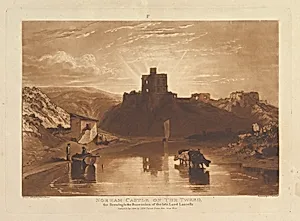
Norham Castle on the Tweed (Liber Studiorum, part XII, plate 57)
Medium
Etching and mezzotint; first state of three
Dimensions
plate: 7 x 10 5/16 in. (17.8 x 26.2 cm) sheet: 8 1/4 x 11 1/2 in. (21 x 29.2 cm)
Classification
Prints
Department
Drawings and Prints
Museum
Metropolitan Museum of Art, New York, NY
Credit
Harris Brisbane Dick Fund, 1928
Accession Number
28.97.57
Rights
Public Domain
Tags
About this artwork
"Norham Castle on the Tweed (Liber Studiorum, part XII, plate 57)" by Joseph Mallord William Turner|Charles Turner|Joseph Mallord William Turner (British) from January 1, 1816 represents an important work in prints. Created in etching and mezzotint; first state of three, this work demonstrates technical skill and artistic vision. As a print, it demonstrates reproductive techniques of the period. The artwork reflects aesthetic values of its time, offering insight into artistic practices and cultu...
Art Historical Context
J.M.W. Turner’s *Norham Castle on the Tweed* belongs to his ambitious *Liber Studiorum* series, a set of seventy prints published between 1807 and 1819 that explored the full range of landscape subjects. This plate, issued in January 1816 as part XII, depicts the ruined medieval fortress overlooking the River Tweed, a site Turner had sketched years earlier and would return to throughout his career. The inclusion of grazing cattle along the riverbank adds a quiet pastoral note, balancing the dramatic silhouette of the castle against the gently flowing water. The work was created through a combination of etching and mezzotint, a technique in which Turner etched the main outlines himself before entrusting the tonal work to engraver Charles Turner. This first state of three reveals the artist’s careful control over light and atmosphere, allowing subtle gradations of shadow and glow to evoke the changing moods of the British landscape. Such prints were not merely reproductions but deliberate experiments in how tonal effects could convey the same emotional power Turner achieved in his paintings. As part of the Metropolitan Museum’s collection of works on paper, this impression preserves Turner’s vision of nature and history at a pivotal moment in British Romantic art. It invites viewers to consider how a single castle ruin could embody both national heritage and the fleeting beauty of light on water.
About the Artist
Joseph Mallord William Turner|Charles Turner|Joseph Mallord William Turner · 1775–1851
Joseph Mallord William Turner, born on 23 April 1775 in London's Covent Garden to barber William Turner and Mary Marshall, emerged as a child prodigy amid personal hardships. His mother suffered mental illness and died in Bethlem Hospital in 1804, while his father supported his early sketches by displaying them in his shop. Around age 10, Turner stayed with his uncle Joseph Mallord William Marshal...