
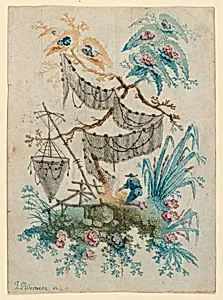
Nouvelle Suitte de Cahiers Chinois, Plate 3
Medium
Classification
Department
Smithsonian Collection
Museum
Smithsonian American Art Museum
Credit
Bequest of Erskine Hewitt
Accession Number
1938-57-19
Rights
Public Domain
About this artwork
Research in Progress
Art Historical Context
Jean-Baptiste Pillement, a prolific French artist of the Rococo era (1728–1808), created *Nouvelle Suitte deiers Chinois, Plate3* around 1780. This print belongs to a series evoking "Chinese notebooks," reflecting Europe's 18th-century obsession withiserie—the whimsical, stylized interpretation of Chinese motifs in Western art. Pillement, celebrated for his delicate landscapes and ornamental designs, drew inspiration from Asian imports and travelogues, blending them with fluid, asymmetrical Rococo lines to craft enchanting decorative fantasies. As a print medium, Plate 3 exemplifies how such works democratized high-style design, allowing motifs of exotic flora, pagodas, and figures to influence textiles, wallpapers, and furniture across elite European homes. Pillement's technique likely involved etching or engraving, capturing intricate patterns with a lightness and elegance that made his cahiers (sketchbooks) highly sought after by artisans and collectors. Housed in the Smithsonian American Art Museum through the bequest of Erskine Hewitt, this piece highlights the cross-cultural exchange of the Enlightenment, where imagination trumped accuracy. Visitors will appreciate its playful fusion of worlds, a testament to Pillement's enduring influence on decorative arts. (198 words)