
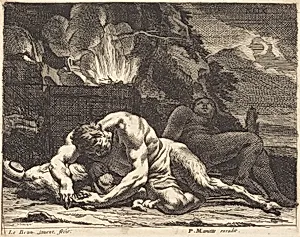
Nox (Night)
c. 1640
Medium
etching with engraving on laid paper
Dimensions
plate: 18.8 x 23.5 cm (7 3/8 x 9 1/4 in.) sheet: 19.4 x 24.4 cm (7 5/8 x 9 5/8 in.)
Classification
Department
CG-E
Museum
National Gallery of Art, Washington, D.C.
Credit
Ailsa Mellon Bruce Fund
Accession Number
2007.18.4
Rights
Public Domain
Art Historical Context
**Nox (Night)**, an exquisite etching with engraving by Charles Le Brun 1640, captures the mythical figure of Night in a poised, allegorical form. Created when Le Brun was just in his early twenties, this on laid paper measures a modest plate size of 18.8 x 23.5 cm, making it an intimate work ideal for close study. As one of the artist's early forays into printmaking, it showcases his budding mastery of line and tone, blending the fluid spontaneity of etching—where acid etches designs into a metal plate—with the precise control of engraving. Le Brun, a pivotal figure in 17th-century French art, would later define the grand classicism of Louis XIV's court as First Painter to the King and director of the Académie Royale. This piece reflects the Baroque era's fascination with classical mythology and dramatic personifications, influenced by Le Brun's Roman training. Prints like *Nox* were revolutionary for their time, democratizing access to high art by allowing reproductions to circulate widely among collectors and scholars. Housed in the National Gallery of Art through the Ailsa Mellon Bruce Fund, *Nox* highlights Le Brun's technical innovation and thematic depth, offering visitors a glimpse into the dawn of French academic art. Its subtle contrasts evoke night's mystery, inviting contemplation of light, shadow, and the eternal cycle of day and night.
About the Artist
Charles Le Brun · 1619–1690
Charles Le Brun (1619–1690) was the most powerful artistic figure in seventeenth-century France, serving as the virtual dictator of official taste during the reign of Louis XIV and shaping the visual identity of the French Baroque in ways that resonated for generations. Born in Paris, he trained under the painter Simon Vouet before traveling to Rome in 1642, where he studied the works of Nicolas P...