
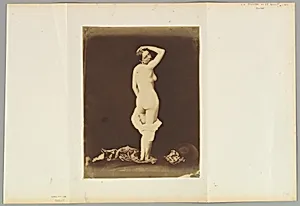
Nude
ca. 1850
Medium
Salted paper print from paper negative
Dimensions
Image: 8 13/16 × 6 3/4 in. (22.4 × 17.2 cm) Mount: 11 5/8 × 8 1/16 in. (29.6 × 20.5 cm)
Classification
Photographs
Department
Photographs
Museum
Metropolitan Museum of Art, New York, NY
Credit
Gilman Collection, Purchase, The Horace W. Goldsmith Foundation Gift, through Joyce and Robert Menschel, 2005
Accession Number
2005.100.1105
Rights
Public Domain
Tags
Art Historical Context
Created around 1850, Félix-Jacques-Antoine Moulin’s “Nude” stands among the earliest surviving photographic studies of the unclothed female figure. Working in Paris during photography’s first decade, Moulin employed the salted paper print process—an early technique in which a paper negative was contact-printed onto light-sensitive paper treated with salt and silver nitrate. The resulting image possesses a soft, matte surface and delicate tonal range that echoes the subtle gradations of a drawing, bridging the gap between traditional art-making and the new medium. At a time when photography was still proving itself as a legitimate artistic tool, images such as this one were often produced as “académies” for painters and sculptors. Moulin’s composition emphasizes graceful contours and natural lighting, inviting viewers to appreciate both the model’s form and the photographer’s command of the fledgling technology. Today, the print’s presence in the Metropolitan Museum’s collection underscores photography’s rapid evolution from scientific curiosity to recognized art form within a single generation.
About the Artist
Félix-Jacques-Antoine Moulin (French) · 1800 –1875
French, 1800–after 1875