
Nude Dancer
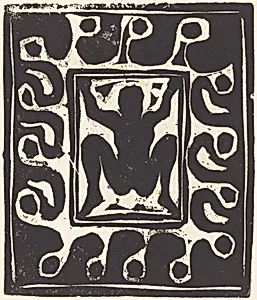
Medium
woodcut in black on buff paper
Dimensions
block: 13.8 x 11.6 cm (5 7/16 x 4 9/16 in.) sheet: 18.7 x 17.8 cm (7 3/8 x 7 in.)
Classification
Department
CG-W
Museum
National Gallery of Art, Washington, D.C.
Credit
Gift of Andrew Robison, in honor of Ruth Cole Kainen
Accession Number
2004.82.1
Rights
Public Domain
Art Historical Context
**Nude Dancer, 1906** Ernst Ludwig Kirchner's *Nude Dancer* is striking woodcut print from the early days of German Expressionism. Created in 1906, this ink on buff paper measures a compact 13.8 x 11.6 cm for the block, capturing a dynamic female figure in motion. As a foundational work in Kirchner's oeuvre, it embodies the raw energy of the human form, with bold, angular lines that twist and elongate the dancer's body. Kirchner co-founded Die Brücke (The Bridge) group in Dresden in 1905, rebelling against academic traditions to infuse art with primal emotion and modern vitality. Influenced by non-Western art and urban life, Expressionists like Kirchner revived the woodcut—a medieval technique—for its direct, carved intensity. Here, the medium's coarse grain and stark contrasts amplify the dancer's sensuous rhythm, evoking primal dances and the era's fascination with primitivism and bodily freedom. Housed in the National Gallery of Art as a gift honoring Ruth Cole Kainen, this print highlights Kirchner's innovative printmaking, bridging fine art and graphic boldness. Visitors will appreciate its visceral power, a snapshot of artistic revolution on the cusp of World War I. (198 words)
About the Artist
Ernst Ludwig Kirchner · 1880–1938
Ernst Ludwig Kirchner was born on May 6, 1880, in Aschaffenburg, Germany, to parents Ernst and Maria Kirchner, part of a family of Prussian descent that frequently relocated due to his father's career as a chemical technician. After early schooling in various towns, he studied architecture at the Königliche Technische Hochschule (Technical University) in Dresden from 1901 to 1905, taking courses i...