
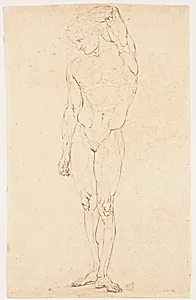
Nude Man Standing with One Arm Raised
early 19th century
Medium
Pen and brown ink, over black chalk
Dimensions
16 1/16 x 10 1/16in. (40.8 x 25.5cm)
Classification
Drawings
Department
Drawings and Prints
Museum
Metropolitan Museum of Art, New York, NY
Credit
Gift of Cephas G. Thompson, 1887
Accession Number
87.12.1
Rights
Public Domain
Tags
Art Historical Context
In the early 19th century, the Neoclassical revival of ancient Greek and Roman ideals, this delicate drawing—attributed to Antonio Canova an anonymous Italian artist of his era—captures a nude standing with one arm gracefully raised. Canova, Italy's preeminent sculptor (1757–1822), was renowned for his marble masterpieces like *The Three Graces*, which celebrated the harmonious male form inspired by antiquity. This sheet likely served as a preparatory study, the pose and anatomy essential for his sculptural works. Executed in pen and brown ink over black chalk on paper (16 1/16 x 10 1/16 inches), the technique reveals a masterful layering: the subtle chalk underdrawing models volume and shadow, while precise ink lines define contours with fluid elegance. Such drawings were vital tools for artists, bridging two-dimensional sketches to three-dimensional sculpture, emphasizing proportion, contrapposto stance, and idealized nudity—a nod to classical heroism. Housed in the Metropolitan Museum of Art's Drawings and Prints department (gift of Cephas G. Thompson, 1887), this intimate work invites visitors to appreciate the preparatory artistry behind grand Neoclassical visions, reminding us how sketches like this breathed life into enduring marble forms.
About the Artist
Antonio Canova|Anonymous, Italian, early 19th century · 1757–1822
Antonio Canova, born on November 1, 1757, in the small town of Possagno in the Republic of Venice, was immersed in sculpture from childhood. His father, Pietro Canova, a stonecutter, died when Antonio was just four, prompting his mother, Angela Zardo Fantolin, to remarry and place him under the care of his paternal grandfather, Pasino Canova. A skilled stonemason and sculptor of late Baroque altar...