
Nude
ca. 1915-1916
Medium
Painting
Classification
Painting
Department
Smithsonian Collection
Museum
Smithsonian American Art Museum
Credit
Smithsonian American Art Museum, Gift of Anna McCleery Newton
Accession Number
1968.121.4
Rights
Public Domain
Tags
About this artwork
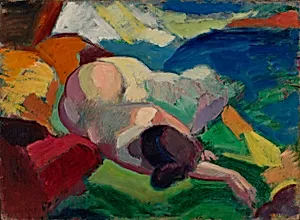
Carl Newman experimented with color by grinding his own pigments to make vibrant hues. He enjoyed painting nude figures and often surrounded his models with blocks of color to create semiabstract compositions. The figure’s bare skin echoes the colors around her so that she appears to blend in with the background, and the blurred outlines and scumbled brushstrokes create a warmly colored, womblike environment.
Art Historical Context
In "Nude," painted around 1915–1916, Carl Newman presents a full-length figure that merges with its surroundings through bold color and soft form. Working during a period of artistic experimentation, Newman ground his own pigments to achieve unusually vibrant hues. He frequently placed his models amid blocks of color, allowing the body to echo and dissolve into the background rather than stand apart from it. The result is a semi-abstract composition where blurred outlines and scumbled brushstrokes create a warm, enveloping space. Rather than emphasizing sharp contours or dramatic lighting, Newman invites viewers to experience the figure as part of a continuous, living environment. This approach highlights his interest in color as both structure and atmosphere. Now part of the Smithsonian American Art Museum’s collection through the generosity of Anna McCleery Newton, the painting offers a quiet yet innovative glimpse into early twentieth-century explorations of the nude.