
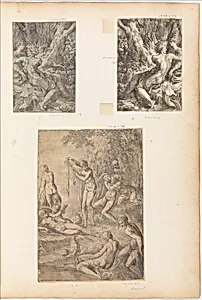
Nymphs Bathing
possibly ca. 1545–50
Medium
Etching
Dimensions
image: 9 1/2 x 6 5/8 in. (24.2 x 16.8 cm) sheet: 9 11/16 x 6 3/4 in. (24.6 x 17.2 cm)
Classification
Prints
Department
Drawings and Prints
Museum
Metropolitan Museum of Art, New York, NY
Credit
Harris Brisbane Dick Fund, 1927
Accession Number
27.78.2(94)
Rights
Public Domain
Tags
Art Historical Context
Andrea Schiavone (Andrea Meldola), a Venetian artist active in the mid-sixteenth century, created this delicate etching around 1545–50. Working in the orbit of Titian and other leading painters of the Venetian school, Schiavone brought a fluid, painterly sensibility to printmaking. The scene depicts a group of nymphs at their bath, rendered with loose, expressive lines that capture both the play of light on water and the graceful movement of figures in a wooded glade. Etching was still a relatively new medium in Italy at the time, prized for its ability to convey spontaneous, sketch-like effects that echoed the freedom of drawings. Schiavone’s prints helped spread the sensuous, classically inspired imagery of Venetian art to a wider European audience. Small in scale yet rich in atmosphere, “Nymphs Bathing” exemplifies the Renaissance fascination with mythological subjects that celebrated beauty, nature, and the harmony of the human form. Acquired by the Metropolitan Museum in 1927 through the Harris Brisbane Dick Fund, the print remains a fine example of how Renaissance artists used the etching technique to explore themes from classical antiquity in an intimate, accessible format.
About the Artist
Andrea Schiavone (Andrea Meldola) · 1510–1563
Andrea Schiavone, born Andrea Meldolla around 1510 or 1515 in Zara (modern Zadar, Croatia), in Venetian-ruled Dalmatia, hailed from a family rooted in Meldola near Forlì in Romagna, Emilia-Romagna. His father, Simon Meldolla, served as a garrison commander there, and both parents originated from Meldola, where the family held property into the early 16th century. Nicknamed "Schiavone"—"the Slav"—a...