
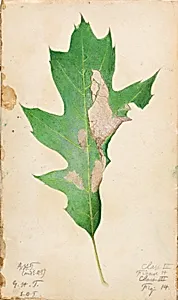
Oak Leaf Edge Caterpillar, study for book Concealing Coloration in the Animal Kingdom
Medium
Painting
Classification
Painting
Department
Smithsonian Collection
Museum
Smithsonian American Art Museum
Credit
Smithsonian American Art Museum, Gift of the heirs of Abbott Handerson Thayer
Accession Number
1950.2.22A
Rights
Public Domain
Tags
Art Historical Context
Behold the intricate *Oak Leaf Edge Caterpillar*, a meticulous painting by Gerald H.ayer, created as a study for his father's seminal book *Concealing Col in the Animal Kingdom*1909). This work captures the caterpillar's astonishing mimicry of an oak leaf ragged edge, blending seamlessly with its surroundings—a testament to the Thayer family's pioneering theories on animal camouflage. Abbott H. Thayer, a prominent American artist and naturalist, argued that many animal colors served protective concealment rather than display, challenging prevailing views in evolutionary biology at the turn of the 20th century. Gerald's precise brushwork highlights the subtle gradations of green, brown, and texture that fool the eye, rendering the insect nearly invisible against foliage. As a preparatory study, it exemplifies the Thayers' commitment to hyper-realistic naturalism, blending scientific observation with artistic mastery. Housed in the Smithsonian American Art Museum through a gift from Abbott's heirs, this piece not only illustrates nature's artistry but also foreshadowed practical applications, like military camouflage during World War I. Visitors, pause to appreciate how this unassuming study bridges art and science, revealing the hidden genius of evolution's designs.