
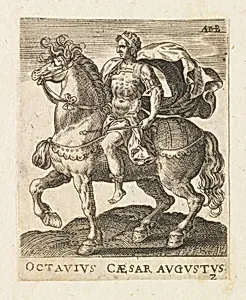
Octavius Caesar Augustus, from "Twelve Caesars on Horseback"
ca. 1565–87
Medium
Engraving
Dimensions
Sheet: 2 5/16 × 1 13/16 in. (5.8 × 4.6 cm)
Classification
Prints
Department
Drawings and Prints
Museum
Metropolitan Museum of Art, New York, NY
Credit
The Elisha Whittelsey Collection, The Elisha Whittelsey Fund, 1951
Accession Number
51.501.7755(2)
Rights
Public Domain
Tags
Art Historical Context
Behold the diminutive yet commanding engraving *Octavius Caesar Augustus from "Twelve Caesars Horseback"* by Flemish artist Abraham de Bruyn, created around 1565–87. This print, measuring just 2 5/16 × 1 13/16 inches, captures the first Roman emperor—born Gaius Octavius Thurinus, later Augustus—astride a noble steed, evoking the grandeur of ancient Rome during Europe's Renaissance revival of classical antiquity. De Bruyn, a master engraver from Antwerp, specialized in detailed series like this one, which romanticized the Twelve Caesars popularized by Suetonius. The engraving medium, an intaglio technique where lines are incised into a metal plate and inked, allowed for precise, reproducible images that brought imperial history to a wide audience. Horses, a recurring motif here, symbolize military prowess and leadership, aligning with equestrian portraits that celebrated rulers' power from antiquity to the Renaissance. Housed in the Metropolitan Museum of Art's Drawings and Prints department, this work from The Elisha Whittelsey Collection highlights 16th-century fascination with Roman legacy. Its tiny scale belies a wealth of detail, inviting visitors to ponder how such prints democratized heroic imagery in an era hungry for the past.