
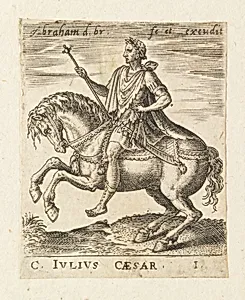
C. Julius Caesar, from "Twelve Caesars on Horseback"
ca. 1565–87
Medium
Engraving
Dimensions
Sheet: 2 5/16 × 1 13/16 in. (5.8 × 4.6 cm)
Classification
Prints
Department
Drawings and Prints
Museum
Metropolitan Museum of Art, New York, NY
Credit
The Elisha Whittelsey Collection, The Elisha Whittelsey Fund, 1951
Accession Number
51.501.7755(1)
Rights
Public Domain
Tags
Art Historical Context
Behold *C. Julius Caesar* from Abraham de Bruyn's series *Twelve Caesars on Horseback* (ca. 1565–87), a delicate engraving measuring just 2 5/16 × 1 13/16 inches. Created by the Flemish artist and publisher Abraham de Bruyn during the Renaissance, this tiny print captures the Roman dictator Julius Caesar astride his mount, evoking the grandeur of ancient Rome. Part of a celebrated series depicting the Twelve Caesars—drawn from Suetonius's lives of the emperors—these works reflect the era's fascination with classical antiquity, blending historical reverence with artistic innovation. Engraving, de Bruyn's chosen medium, allowed for intricate details in the horse's musculature, Caesar's armor, and dynamic pose, making complex imagery reproducible and affordable for collectors across Europe. This technique was pivotal in the 16th century, fueling the spread of humanist ideals through portable prints rather than grand paintings. Housed in the Metropolitan Museum of Art's Drawings and Prints department, thanks to The Elisha Whittelsey Collection, it exemplifies how Renaissance artists revived imperial equestrian portraits, inspired by ancient coins and sculptures. Imagine flipping through a collector's album in a candlelit study—this petite gem brought Caesar's legendary conquests vividly to life, reminding viewers of Rome's enduring legacy in an age of exploration and rediscovery.