
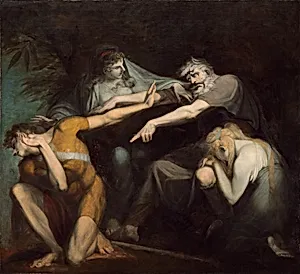
Oedipus Cursing His Son Polynices
1786
Medium
oil on canvas
Dimensions
overall: 149.8 x 165.4 cm (59 x 65 1/8 in.) framed: 177.2 x 191.8 x 12.3 cm (69 3/4 x 75 1/2 x 4 13/16 in.)
Classification
Painting
Department
CAB
Museum
National Gallery of Art, Washington, D.C.
Credit
Paul Mellon Collection
Accession Number
1983.1.41
Rights
Public Domain
Art Historical Context
In this dramatic oil painting, four figures fill a shadowy, enclosed space with intense emotion. At the center, an elderly man with flowing white hair and beard leans forward, his arm outstretched in accusation toward a muscular younger man kneeling on the ground. The younger figure, clad in a bright orange tunic, shields his face in distress, while two women react with anguish—one extending her arm protectively between the men, the other bowed low with her head in her hands. Strong contrasts of light and dark heighten the tension, and the expressive gestures and twisted poses draw the eye across the canvas. Henry Fuseli painted Oedipus Cursing His Son Polynices in 1786, drawing on the ancient Greek tragedy by Sophocles. Known for his powerful depictions of literary and mythological subjects, Fuseli often explored moments of high drama and human conflict through bold compositions and theatrical lighting. This work exemplifies his ability to convey raw emotion and moral weight, inviting viewers to reflect on themes of fate, family, and retribution that have resonated across centuries.
About the Artist
Henry Fuseli · 1741–1825
Henry Fuseli (1741-1825), born Johann Heinrich Füssli in Zürich, was a Swiss-British painter whose visionary works exploring dreams, nightmares, and psychological terror made him one of the most original figures of the Romantic movement. His art bridged Neoclassical discipline with Romantic emotionalism, creating images of supernatural intensity that would influence artists from William Blake to t...