
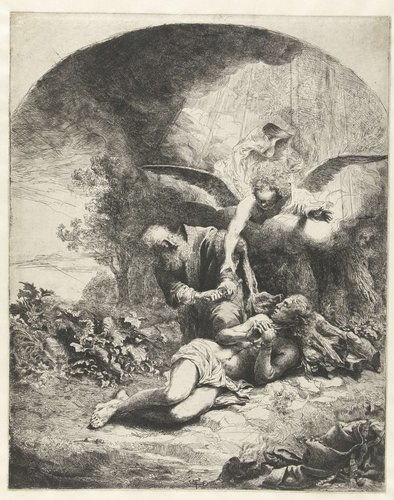
Offer van Abraham
1632 - 1680
Medium
etching
Dimensions
411; 325
Rights
Public Domain
About this artwork
ets en droge naald
Art Historical Context
Ferdinand Bol's *Offer van Abraham* (Sacrifice of Abraham), created during his active years from 1632 to 1680, captures the dramatic moment when Abraham prepares to sacrifice his son Isaac only to be halted by divine intervention. As a prominent Dutch Golden Age artist and former pupil of Rembrandt van Rijn, Bol infused his works with the emotional intensity and chiaroscuro lighting characteristic of Rembrandt's circle, making this etching a poignant exploration of faith, obedience, and mercy. Rendered in etching combined with drypoint—a technique denoted by the Dutch "ets en droge naald"—the print measures an impressive 411 mm high by 325 mm wide. Etching allowed Bol to incise precise lines into a metal plate with acid for fluid, expressive forms, while drypoint's direct needle scratches created a soft, velvety burr, adding rich texture and depth to the figures' drapery and anguished expressions. This hybrid method was innovative in 17th-century printmaking, bridging painting's intimacy with the reproducibility of prints. In the context of Dutch art, Bol's work reflects the era's fascination with Old Testament narratives, often used to convey moral and theological lessons to a Protestant audience. This etching stands as a testament to Bol's mastery in translating painterly drama to paper, offering visitors a window into the technical brilliance and spiritual depth of Golden Age printmaking.
About the Artist
Ferdinand Bol · 1616–1680
As a very young man, Bol moved to Amsterdam, where he worked under the direction of Rembrandt, with whom he formed a friendship. Comment on works: Religious; History; Portraits