
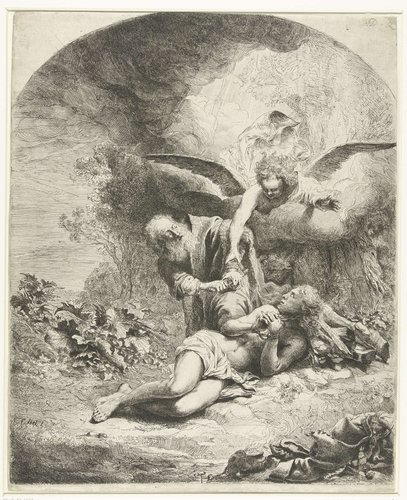
Offer van Abraham
1632 - 1680
Medium
etching
Dimensions
399; 326
Rights
Public Domain
About this artwork
ets en droge naald
Art Historical Context
Ferdinand Bol's *Offer van Abraham* (Sacrifice of Abraham), created sometime between 1632 and 1680, captures the biblical moment when Abraham prepares to sacrifice his son Isaac only to be halted by divine intervention. As a prominent Dutch artist of the Golden Age and a favored pupil of Rembrandt, Bol his works with the intense chiaroscuro and emotional depth of Baroque style. This etching reflects the era's fascination with Old Testament narratives, which served as moral and spiritual touchstones for 17th-century audiences. Rendered in etching combined with drypoint—a technique denoted by the Dutch "ets en droge naald"—the print showcases Bol's mastery of intaglio methods. Etching allowed precise, fluid lines incised into a copper plate with acid, while drypoint's direct needle scratches created velvety burrs for rich tonal contrasts and texture. Measuring a substantial 399 × 326 mm, this large-format work would have been prized for its reproductive potential, enabling wide dissemination of Bol's artistry beyond paintings. In the context of Dutch printmaking's heyday, *Offer van Abraham* exemplifies how artists like Bol elevated prints from mere copies to independent masterpieces, blending technical innovation with profound religious symbolism. Visitors will appreciate its brooding atmosphere, a testament to the era's artistic ambition.
About the Artist
Ferdinand Bol · 1616–1680
As a very young man, Bol moved to Amsterdam, where he worked under the direction of Rembrandt, with whom he formed a friendship. Comment on works: Religious; History; Portraits