
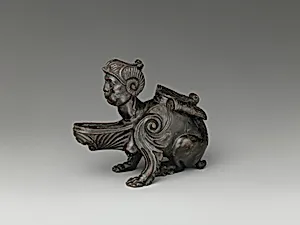
Oil Lamp in the Form of a Sphinx
mid-16th century
Medium
Bronze
Dimensions
confirmed: 4 7/8 × 2 3/8 × 5 3/4 in., 1.9 lb. (12.4 × 6 × 14.6 cm, 0.9 kg)
Classification
Sculpture-Bronze
Culture
Italian, Padua
Department
European Sculpture and Decorative Arts
Museum
Metropolitan Museum of Art, New York, NY
Credit
Rogers Fund, 1911
Accession Number
11.38.2
Rights
Public Domain
Tags
Art Historical Context
Behold the *Oil Lamp in the Form a Sphinx*, a masterful bronze sculpture crafted by Andreariosco, known ascio, in mid-16th-century Pad, Italy. Measuring just 4 7/8 × 2 3/8 × 5 3/4 inches, this diminutive yet captivating piece transforms a humble oil lamp into a mythical guardian, its sphinx form evoking the enigmatic creatures of ancient Egyptian and Greek lore—half-human, half-lion symbols of riddles and protection. Riccio, a leading figure in the Paduan Renaissance excelled in small-scale bronzes, often drawing from classical antiquity to blend intricate detailing with whimsical grotesques. Likely cast using the lost-wax technique, this work showcases his virtuosity in capturing the sphinx's poised ferocity and subtle textures, from the taut muscles to the stylized wings and human face. Such functional objets d'art were prized in Renaissance households and studioli, merging everyday utility with scholarly delight in mythology. Housed in the Metropolitan Museum of Art's European Sculpture and Decorative Arts Department (acquired via the Rogers Fund in 1911), this lamp exemplifies Padua's bronze-casting legacy, bridging ancient motifs with Renaissance ingenuity. It invites visitors to ponder: what secrets might this sphinx illuminate in the flickering glow of its own flame?
About the Artist
Andrea Briosco, called Riccio · 1470–1532
Andrea Briosco, better known by his nickname Riccio ("curly-headed"), was born around 1470 in Padua, the vibrant intellectual hub of Renaissance northern Italy, and died there in 1532. The son of goldsmith Ambrogio di Cristoforo Briosco, he received his initial training in his father's workshop, mastering the delicate techniques of metalwork essential for his future mastery of bronze. Riccio then ...