
Oil or Vinegar Cruet
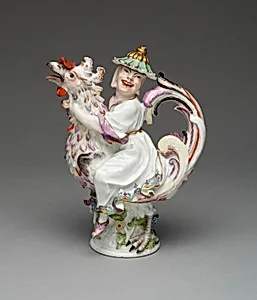
Medium
Enameled and gilded hard-paste porcelain
Dimensions
21.3 × 16.1 × 9.3 cm (8 3/8 × 6 5/16 × 3 5/8 in.)
Classification
tableware
Department
Applied Arts of Europe
Museum
Art Institute of Chicago
Accession Number
147508
Rights
Public Domain
About this artwork
Typifying the splendor of the Saxon court at Dresden during the eighteenth century, this porcelain centerpiece would have been part of an elaborate dinner service that graced ceremonial court banquet tables. Remarkable for its large size and luxurious decoration, the service was designed for Count Heinrich von Brühl, who was both administrator of the Royal Saxon Porcelain Manufactory at Meissen and prime minister to Augustus III (r. 1733–63), elector of Saxony and king of Poland. The centerpiece...
Art Historical Context
Step into the opulent world of 18-century European dining with this exquisite *Oil or Vinegar Cruet from the Meissen Porcelain Manufactory, crafted around 1737. Produced in Germany, Meissen was Europe's pioneering factory for hard-paste porcelain—a true technical marvel that rivaled prized Chinese imports. This functional tableware piece, standing at 21.3 × 16.1 × 9.3 cm, transforms everyday condiments into a statement of luxury, perfect for aristocratic banquets during the lavish Rococo era. The cruet's hard-paste porcelain body is masterfully enameled and gilded, showcasing Meissen's unrivaled skill in overglaze decoration. Vibrant enamels allowed for intricate, colorful motifs, while gilding added a shimmering gold accents that caught the candlelight. This technique not only enhanced durability but elevated porcelain from curiosity to high art, symbolizing wealth and sophistication. Housed in the Art Institute of Chicago's Department of Applied Arts of Europe, this cruet highlights how Meissen blurred the line between utility and artistry, influencing tableware design across the continent. A delightful glimpse into royal indulgence!
About the Artist
Meissen Porcelain Manufactory
The Meissen Porcelain Manufactory, established on June 6, 1710, by Augustus II the Strong, Elector of Saxony and King of Poland, in the Albrechtsburg castle at Meissen near Dresden, marked Europe's breakthrough in producing true hard-paste porcelain. Building on experiments by physicist Ehrenfried Walther von Tschirnhaus and alchemist Johann Friedrich Böttger, who perfected the formula using local...