
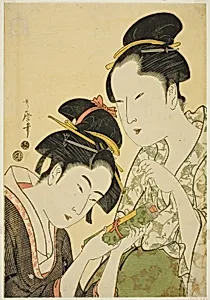
Okita and Ofuji
c. 1793/94
Medium
Color woodblock print; oban
Dimensions
36.2 × 25.1 cm (14 1/4 × 9 7/8 in.)
Classification
woodblock print
Department
Arts of Asia
Museum
Art Institute of Chicago
Accession Number
77438
Rights
Public Domain
Art Historical Context
**Okita and Ofuji**, a captivating color woodblock print by the renowned Japanese artist Kitagawa Utamaro (c. 1753–1806), dates to around 1793/94. This oban-sized work (36.2 × 25.1 cm) showcases Utamaro's mastery in the ukiyo-e tradition, the "pictures of the floating world" that celebrated the vibrant, ephemeral pleasures of Edo-period (1603–1868) urban life. The title refers to two elegant women—likely courtesans from the Yoshiwara pleasure district—rendered with Utamaro's signature grace, their flowing kimonos and poised expressions evoking beauty and allure. Utamaro was a leading figure in the bijin-ga genre, specializing in portraits of beautiful women, and this print exemplifies his innovative techniques. Multiple woodblocks were meticulously carved and layered to achieve rich, nuanced colors and subtle gradients, from the soft flush of skin to intricate textile patterns. Such prints were affordable art for the masses, democratizing high culture during Japan's Edo era. Housed in the Art Institute of Chicago's Arts of Asia department, *Okita and Ofuji* offers a window into 18th-century Japanese society, where art blurred lines between entertainment and eroticism. Its delicate artistry continues to enchant, highlighting Utamaro's enduring influence on global printmaking. (198 words)
About the Artist
Kitagawa Utamaro · 1753–1806
Kitagawa Utamaro (c. 1753-1806) was one of the most celebrated masters of ukiyo-e woodblock printing, revolutionizing the art of bijin-ga (pictures of beautiful women) during Japan's Edo period. Born Kitagawa Ichitaro, his early life remains shrouded in mystery, with conflicting accounts placing his birth in Kyoto, Osaka, Yoshiwara in Edo (modern Tokyo), or Kawagoe in Musashi Province. Under the t...