
Old Battersea Bridge
1879/87
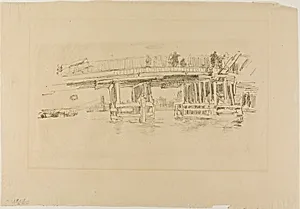
Medium
Lithograph, in black ink, with scraping, on tan laid paper
Dimensions
Image: 14.4 × 33.2 cm (5 11/16 × 13 1/8 in.); Sheet: 30.9 × 45 cm (12 3/16 × 17 3/4 in.)
Classification
lithograph
Department
Prints and Drawings
Museum
Art Institute of Chicago
Accession Number
109179
Rights
Public Domain
Art Historical Context
James McNeill Whistler’sOld Battersea Bridge*1879/87) captures the misty allure of London’s Thames River in a delicate lithograph, printed in black ink with subtle scraping on tan laid paper. As an American expatriate artist embraced by the British avant-garde, Whistler was a pioneer of Aestheticism, prioritizing "art for art’s sake" through harmonious compositions and tonal subtlety. This print belongs to his Thames series, evoking the foggy, industrial atmosphere of Victorian London around the old wooden Battersea Bridge, which spanned the river before its 1890 replacement. Whistler elevated lithography—a planographic printing technique using greasy crayon on stone—from commercial reproduction to fine art. Here, he employs scraping to create velvety textures and soft edges, mimicking etching’s line quality while achieving atmospheric depth on the modest 14.4 × 33.2 cm image. This innovative approach reflects his nocturne style, seen in famous oil paintings like those of the Thames, blending Japanese print influences with impressionistic mood. Housed in the Art Institute of Chicago’s Prints and Drawings Department, this work highlights Whistler’s mastery of printmaking amid his battles with critics like John Ruskin. For visitors, it offers a poetic glimpse into a vanishing London, where fog-shrouded bridges symbolized modernity’s quiet poetry.
About the Artist
James McNeill Whistler · 1834–1903
James Abbott McNeill Whistler (1834-1903) was an American-born painter and printmaker who became a leading figure in the Aesthetic Movement and pioneer of Tonalism and Japonisme. He revolutionized art by championing "art for art's sake" and treating paintings as visual equivalents of musical compositions, titling works as "arrangements," "harmonies," and "nocturnes" to emphasize formal qualities o...