
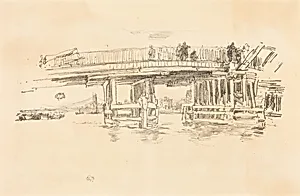
Old Battersea Bridge
1879/1887
Medium
lithograph in black on wove paper
Dimensions
image: 14.4 × 33.2 cm (5 11/16 × 13 1/16 in.) sheet: 28.8 × 46.1 cm (11 5/16 × 18 1/8 in.)
Classification
Department
CG-W
Museum
National Gallery of Art, Washington, D.C.
Credit
Rosenwald Collection
Accession Number
1943.3.8672
Rights
Public Domain
Art Historical Context
James McNeill Whistler, leading figure in the Aesthetic movement, captured the moody allure of London's Thames River in *Old Battersea Bridge*1879/1887). This lithograph depicts the aging wooden bridge, a relic of 18th-century engineering amid the city's industrial haze, rendered in subtle tones that evoke Whistler's signature nocturne style—prioritizing atmospheric harmony over literal detail. Whistler, an American expatriate in Britain, often portrayed the Thames to celebrate its beauty, challenging Victorian preferences for narrative art with his "art for art's sake" philosophy. Printed in black ink on wove paper, the work measures a compact 14.4 × 33.2 cm for the image, showcasing Whistler's mastery of lithography. This technique, involving greasy crayon drawings transferred to stone for inking and printing, allowed him to achieve velvety textures and fluid lines reminiscent of his etchings. Produced during a period of experimentation (note the dual dates, possibly indicating revisions), it reflects his innovative approach to printmaking as fine art, not mere reproduction. Housed in the National Gallery of Art's Rosenwald Collection, this print highlights Whistler's influence on modern art, bridging Impressionism and Symbolism. Visitors can appreciate how it distills urban twilight into poetic simplicity, inviting contemplation of London's evolving skyline.
About the Artist
James McNeill Whistler · 1834–1903
James Abbott McNeill Whistler (1834-1903) was an American-born painter and printmaker who became a leading figure in the Aesthetic Movement and pioneer of Tonalism and Japonisme. He revolutionized art by championing "art for art's sake" and treating paintings as visual equivalents of musical compositions, titling works as "arrangements," "harmonies," and "nocturnes" to emphasize formal qualities o...