
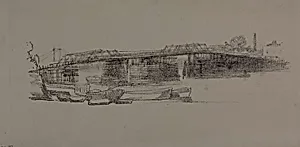
Old Battersea Bridge, No. 2
1878/79
Medium
Transfer lithograph in black on ivory plate paper
Dimensions
Image: 7 × 26.9 cm (2 13/16 × 10 5/8 in.); Sheet: 15.5 × 34.2 cm (6 1/8 × 13 1/2 in.)
Classification
transfer lithograph
Department
Prints and Drawings
Museum
Art Institute of Chicago
Accession Number
139481
Rights
Public Domain
Art Historical Context
Step into the misty allure of James McNeill Whistler's *Old Battersea Bridge,. 2* (1878/79), a delicate transfer lithograph that captures the iconic London landmark along the Thames River. Whistler, the American-born artist renowned for his Aestheticist principles and subtle tonal harmonies, produced this intimate print during his prolific London years. Measuring just 7 × 26.9 cm, its elongated horizontal format draws the eye across the bridge's graceful arches, evoking the industrial poetry of Victorian England. Printed in black ink on creamy ivory plate paper, this transfer lithograph showcases Whistler's innovative technique: he drew fluidly on transfer paper, which was then pressed onto a lithographic stone for editioning. This method allowed him to achieve painterly effects akin to his famous oil nocturnes, blending soft edges and atmospheric depth without rigid lines. Battersea Bridge, a symbol of 19th-century urban progress, appears here in Whistler's signature "art for art's sake" style—prioritizing mood and harmony over narrative detail. Housed in the Art Institute of Chicago's Prints and Drawings Department, this work highlights Whistler's mastery of printmaking as an extension of his painting practice. It invites visitors to appreciate how a humble medium can distill the magic of twilight over the Thames, bridging everyday scenery with timeless beauty.
About the Artist
James McNeill Whistler · 1834–1903
James Abbott McNeill Whistler (1834-1903) was an American-born painter and printmaker who became a leading figure in the Aesthetic Movement and pioneer of Tonalism and Japonisme. He revolutionized art by championing "art for art's sake" and treating paintings as visual equivalents of musical compositions, titling works as "arrangements," "harmonies," and "nocturnes" to emphasize formal qualities o...