
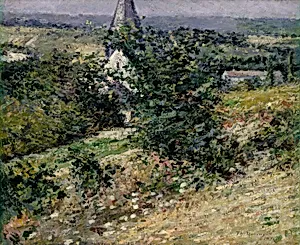
Old Church at Giverny
Medium
Painting
Classification
Painting
Department
Smithsonian Collection
Museum
Smithsonian American Art Museum
Credit
Smithsonian American Art Museum, Gift of William T. Evans
Accession Number
1909.9.6
Rights
Public Domain
Tags
About this artwork
Old Church at Giverny was painted in the summer of 1891 and depicts the west elevation and conical tower of the Church of Sainte Radegonde in the French village of Giverny, located fifty miles from Paris on the River Seine. In the late nineteenth century, France was an international center of artistic training and production and was a popular destination for American painters and collectors. Typically, American artists would settle in Paris but also make regular excursions into the French countr...
Art Historical Context
Theodore Robinson’s *Old Church at Giverny* (1891) captures the west elevation and conical tower of the Church of Sainte Radegonde in the quiet French village where Claude Monet had settled eight years earlier. Painted during Robinson’s extended stay in Giverny, the work reflects the late-nineteenth-century practice of American artists traveling to France for both academic training and the chance to paint outdoors in the countryside. By focusing on the centuries-old church rather than the modern changes then reshaping French towns, Robinson presents Giverny as a place where history and nature still coexist peacefully. Robinson’s close friendship with Monet is evident in the painting’s loose, light-filled brushstrokes that suggest rather than define form. These Impressionist techniques allowed him to record the shifting effects of sunlight on stone and foliage with remarkable immediacy. The result is a canvas that feels both intimate and atmospheric, inviting viewers to sense the gentle rhythm of village life. Acquired by the Smithsonian American Art Museum through the generosity of William T. Evans, *Old Church at Giverny* stands as an important example of American Impressionism and the transatlantic artistic exchange that flourished in the 1890s.