
Old Man in Meditation, Leaning on a Book
ca. 1645
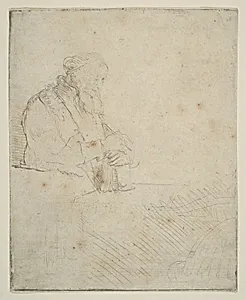
Medium
Etching and drypoint; second of two states
Dimensions
Sheet (Trimmed): 5 1/4 × 4 1/4 in. (13.4 × 10.8 cm)
Classification
Prints
Department
Drawings and Prints
Museum
Metropolitan Museum of Art, New York, NY
Credit
Gift of Felix M. Warburg and his family, 1941
Accession Number
41.1.61
Rights
Public Domain
Tags
Art Historical Context
Created around 1645 during the height of the Dutch Golden Age, Rembrandt van Rijn’s “Old Man in Meditation, Leaning on a Book” captures a quiet moment of introspection. The elderly figure, absorbed in thought with his hand resting on an open volume, reflects Rembrandt’s lifelong fascination with the inner lives of scholars, saints, and ordinary people. Working in etching and drypoint on a small sheet measuring just over five inches tall, the artist achieves remarkable depth and texture through delicate lines and velvety shadows. Rembrandt was a master printmaker who continually revisited his plates, and this impression represents the second of two states. The addition of drypoint burr softens the contours and heightens the sense of contemplative stillness. Such intimate prints were prized by collectors for their expressive power and technical brilliance, allowing viewers to study Rembrandt’s subtle handling of light and form up close. Housed today in the Metropolitan Museum of Art as part of the 1941 gift from the Warburg family, the work invites modern audiences to pause alongside the figure and consider the timeless connection between knowledge, reflection, and the printed image.
About the Artist
Rembrandt (Rembrandt van Rijn) · 1606–1669
Rembrandt Harmenszoon van Rijn (1606–1669) stands as one of the greatest visual artists in the history of Western art and the most important Dutch painter of the 17th century. Born in Leiden to a prosperous miller's family, Rembrandt transformed painting through his revolutionary use of light and shadow, his psychological depth in portraiture, and his elevation of etching to a fine art. His approx...