
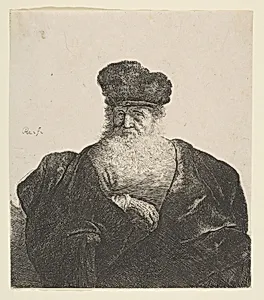
Old Man with Beard, Fur Cap, and Velvet Cloak
ca. 1631
Medium
Etching; third state
Dimensions
Sheet: 5 13/16 × 5 1/8 in. (14.8 × 13 cm)
Classification
Prints
Department
Drawings and Prints
Museum
Metropolitan Museum of Art, New York, NY
Credit
Bequest of Harry G. Friedman, 1965
Accession Number
66.521.69
Rights
Public Domain
Tags
Art Historical Context
In the hallowed halls of the Metropolitan Museum of, Rembrandt van Rijn's *Old Man with Beard, Fur Cap, Velvet Cloak* (ca. 1631) stands as a gem of Dutch Golden Age printmaking. This intimate etching, measuring just 5 13/16 × 5 /8 inches, captures a weathered elder gazing pensively, his fur cap and velvet cloak rendered with exquisite tactile detail. Acquired through the bequest of Harry G. Friedman 1965, it Rembrandt's early mastery during his Leiden period, just before his rise in Amsterdam. As a third-state impression, this print reveals Rembrandt's iterative genius: he refined the copper plate multiple times, adding drypoint lines and burr for velvety textures that mimic oil painting's richness. Etching allowed him to achieve unprecedented tonal depth and psychological intensity, making affordable yet profound portraits accessible beyond elite patrons. The old man's furrowed face and luxurious attire evoke 17th-century burgher life, blending realism with dramatic chiaroscuro—a hallmark of Baroque art. This work highlights Rembrandt's innovative print techniques, influencing generations of artists. Visitors often marvel at how such a small sheet conveys profound humanity, inviting us to ponder the stories etched in every line.
About the Artist
Rembrandt (Rembrandt van Rijn) · 1606–1669
Rembrandt Harmenszoon van Rijn (1606–1669) stands as one of the greatest visual artists in the history of Western art and the most important Dutch painter of the 17th century. Born in Leiden to a prosperous miller's family, Rembrandt transformed painting through his revolutionary use of light and shadow, his psychological depth in portraiture, and his elevation of etching to a fine art. His approx...