
Old Million Eyes
1910
Medium
lithograph
Classification
Department
CG-W
Museum
National Gallery of Art, Washington, D.C.
Credit
Rosenwald Collection
Accession Number
1943.3.7297
Rights
Public Domain
Art Historical Context
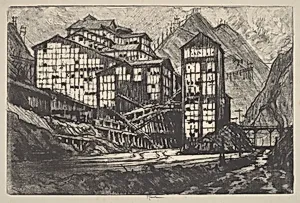
Joseph Pennell's *Old Million Eyes* (191) is a striking lithograph that captures the artist's fascination with America's booming urban landscapes. Pennell, a leading figure in the American printmaking revival of the late 19th early 20th centuries, was for his bold, atmospheric depictions of architecture, industry, and cityscapes. Working in the Progressive Era, when skyscrapers were transforming New York into a vertical marvel, he often portrayed these structures with dramatic light and shadow, evoking both awe and the relentless energy of modernization. As a lithograph—a planographic technique invented in the late 18th century—*Old Million Eyes* showcases Pennell's mastery of crayon and tusche on stone, allowing for rich tonal variations and intricate details reproduced in multiples. The evocative title likely personifies the countless windows ("eyes") of towering buildings, symbolizing the watchful gaze of the modern metropolis. This print exemplifies Pennell's impressionistic style, blending realism with expressive flair to highlight the cultural shift toward urban ambition. Housed in the National Gallery of Art's Rosenwald Collection—a treasure trove of fine prints donated by collector Lessing J. Rosenwald—this work invites visitors to ponder how art documented the birth of the skyline, bridging technology and human vision in early 20th-century America.
About the Artist
Joseph Pennell · 1857–1926
Joseph Pennell (1857–1926) was born in Philadelphia to Quaker parents and displayed an early aptitude for drawing, finding solace in sketching amid a challenging childhood. He received initial drawing instruction from James R. Lambdin and his first etching lessons from Stephen Ferris in 1879. Pennell attended night classes at the Pennsylvania Museum and School of Industrial Art before studying at ...