
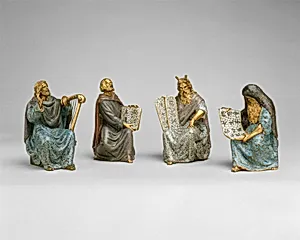
清 掐絲琺瑯舊約聖經四人物|Old Testament figures
Unknown Artist
18th century
Medium
Cloisonné
Dimensions
Overall (a David): H. 4 7/8 in. (12.4 cm); W. 3 5/16 in. (8.5 cm); D. 3 1/4 in. (8.3 cm) Overall (b Moses): H. 5 5/16 in. (13.5 cm); W. 3 5/16 in. (8.5 cm); D. 3 5/16 in. (8.5 cm) Overall (c young Isaiah): H. 4 3/4 in. (12.1 cm); W. 2 11/16 in. (6.8 cm); D. 3 1/4 in. (8.3 cm) Overall (d old Isaiah): H. 4 3/4 in. (12.1 cm); W. 3 1/4 in. (8.3 cm); D. 3 1/4 in. (8.3 cm)
Classification
Cloisonné
Culture & Period
China · Qing dynasty (1644–1911)
Department
Asian Art
Museum
Metropolitan Museum of Art, New York, NY
Credit
Gift of Mr. and Mrs. Edmond J. Safra, 1997
Accession Number
1997.115a–d
Rights
Public Domain
Tags
Art Historical Context
This enchanting set of four cloisonné enamel figures from 18th-century Qing dynasty (1644–1911) depicts Old Testament figures: David, Moses a young Isaiah, and an aged Isaiah. Standing just 4 to 5 inches tall, these diminutive sculptures—ranging from 12.1 to 13.5 cm in height—capture the prophets and king in contemplative poses, adorned with symbolic attributes like tablets and harps suggested by their iconography. Cloisonné, a of imperial Chinese workshops, involves meticulously shaping fine metal wires into intricate cells on a copper body, filling them with vibrant vitreous enamels, and firing multiple times to achieve luminous, durable color. This technique, perfected in China by the 15th century and flourishing under Qing emperors, lent these figures a jewel-like brilliance, blending technical virtuosity with narrative depth. Remarkably, these works bridge Eastern craftsmanship and Western religious themes, hinting at cultural exchanges during a period of Jesuit missionary activity in China. Now in the Metropolitan Museum of Art's Asian Art Department, gifted by Mr. and Mrs. Edmond J. Safra in 1997, they invite visitors to ponder the global currents shaping Qing artistry.