
Old Wood Ladle
1935/1942
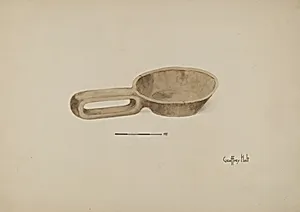
Medium
watercolor, graphite, and pen and ink on paper
Dimensions
sheet: 24.4 × 35 cm (9 5/8 × 13 3/4 in.)
Classification
Index of American Design
Department
CG-W
Museum
National Gallery of Art, Washington, D.C.
Credit
Index of American Design
Accession Number
1943.8.9722
Rights
Public Domain
Art Historical Context
**Old Wood Ladle** by Geoffrey Holt captures the humble beauty of American folk craft through a meticulous rendering created between 1935 and 1942. As part of the Index of American Design—a groundbreaking WPA Federal Art Project during the Great Depression—this watercolor, graphite, and pen-and-ink drawing on paper (24.4 × 35 cm) documents everyday objects that embodied the nation's cultural heritage. Holt, one of over 400 artists involved, transformed a simple wooden ladle—likely a utilitarian tool from early American kitchens—into a vibrant study, preserving its form and patina for posterity. The artwork's mixed media showcase Holt's skill: soft watercolors evoke the wood's warm tones and age-worn textures, while graphite and fine pen lines provide precise contours and intricate details, such as the ladle's ergonomic curve and subtle grain. This technique mirrored the Index's mission to create accurate, colorful records of regional crafts, from Shaker furniture to Native American pottery, amid economic hardship. Today, housed in the National Gallery of Art, **Old Wood Ladle** reminds us of America's inventive spirit and the value of ordinary artifacts. It highlights how the project not only employed artists but also fostered national pride in folk traditions, bridging fine art and vernacular design.
About the Artist
Geoffrey Holt · 1855–present
Geoffrey Holt was born in England on August 18, 1882, and received his artistic training in London and Paris before eventually making his career in the United States. After arriving in America, he lived in Minneapolis, where he worked as an interior designer for the John S. Bradstreet Company—an experience that developed his sensitivity to space, surface, and decorative harmony. By around 1920 he ...