
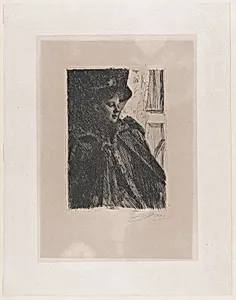
Olga Bratt
Medium
Etching; second state of two
Dimensions
Plate: 7 7/8 × 5 1/2 in. (20 × 14 cm) Sheet: 15 5/8 × 12 1/4 in. (39.7 × 31.1 cm)
Classification
Prints
Department
Drawings and Prints
Museum
Metropolitan Museum of Art, New York, NY
Credit
Bequest of Ida Kammerer, in memory of her husband, Frederic Kammerer, M.D., 1933
Accession Number
33.79.15
Rights
Public Domain
Tags
Art Historical Context
Anders Zorn’s 1892 etching *Olga Bratt* captures the quiet presence of its subject with remarkable economy and sensitivity. Created during the height of Zorn’s international reputation, the print reflects the Swedish artist’s lifelong fascination with portraiture and his ability to suggest personality through delicate line work rather than elaborate detail. As a second-state impression, the plate shows the refinements Zorn made after the first proof, demonstrating his meticulous approach to the medium. Etching allowed Zorn to achieve the luminous skin tones and soft shadows that became hallmarks of his style. The restrained scale of the plate—roughly eight by five-and-a-half inches—invites close viewing, rewarding the observer with subtle gradations of tone that evoke the sitter’s contemplative mood. Produced at a moment when photography was beginning to challenge traditional portraiture, Zorn’s print affirms the enduring expressive power of hand-pulled intaglio techniques. Now part of the Metropolitan Museum of Art’s collection through the bequest of Ida Kammerer, this work offers today’s visitors an intimate glimpse into both the sitter and the artist’s technical mastery at the fin de siècle.
About the Artist
Anders Zorn|Olga Bratt · 1860–1920
Anders Zorn (1860–1920), one of Sweden's most celebrated artists, was born on February 18 in Utmeland near Mora in Dalarna, and raised on his maternal grandparents' farm in the nearby hamlet of Yvraden. Displaying prodigious talent from a young age, he attended school in Mora Strand until age twelve, followed by secondary grammar school in Enköping, where he excelled in drawing people and horses. ...