
Omega's Death
1908/1909
Medium
lithograph in black
Dimensions
stone: 35 x 54.4 cm (13 3/4 x 21 7/16 in.) sheet: 47.7 x 65 cm (18 3/4 x 25 9/16 in.)
Classification
Portfolio
Department
CG-E
Museum
National Gallery of Art, Washington, D.C.
Credit
The Epstein Family Collection
Accession Number
2002.10.11
Rights
Public Domain
Art Historical Context
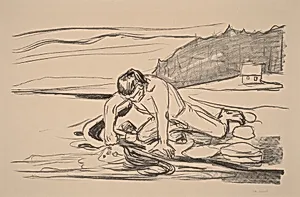
Edvard Munch's *Omega's Death* (1908/1909) is a haunting black lithograph from hisAlpha and Omega* portfolio a series of eight prints exploring themes of love, madness, and mortality. As a pioneer of Expressionism, Munch drew from his own turbulent life—marked by the early deaths of family members and his own mental health struggles—to infuse his work with raw emotional intensity. This piece, printed on a stone measuring 35 x 54.4 cm, captures the artist's fascination with life's finality, with "Omega" symbolizing end. Lithography, Munch's favored medium here, allowed him to achieve dramatic contrasts of light and shadow through greasy crayon drawings on limestone, inked, and transferred to paper (sheet: 47.7 x 65 cm). Unlike paintings, prints enabled wider dissemination of his iconic motifs, bridging elite art with broader audiences during Europe's fin-de-siècle anxiety. Created shortly after Munch underwent electroshock therapy in 1908, it reflects his psychological recovery and preoccupation with death's grip. Housed in the National Gallery of Art's Epstein Family Collection (Department CG-E), *Omega's Death* exemplifies Munch's innovative printmaking, blending Symbolist narrative with modernist distortion. Visitors are drawn to its stark, ghostly forms—a testament to how personal anguish birthed universal resonance.
About the Artist
Edvard Munch · 1863–1944
Edvard Munch (1863-1944) was a Norwegian painter and printmaker whose intensely psychological works made him a pioneer of Expressionism and one of the most influential artists of the modern era. His 1893 masterpiece 'The Scream' has become an iconic symbol of existential anxiety. Munch's art was profoundly shaped by personal tragedy—his mother died when he was five, his beloved sister Sophie at fo...