
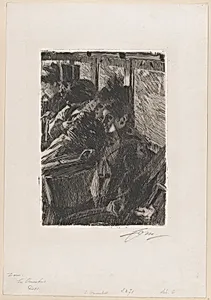
Omnibus
1892
Medium
Etching; third state of three
Dimensions
Plate: 11 in. × 7 3/4 in. (27.9 × 19.7 cm) Sheet: 17 5/8 × 12 3/16 in. (44.8 × 31 cm)
Classification
Prints
Department
Drawings and Prints
Museum
Metropolitan Museum of Art, New York, NY
Credit
Harris Brisbane Dick Fund, 1917 Harris Brisbane Dick Fund, 1917
Accession Number
17.3.672
Rights
Public Domain
Tags
Art Historical Context
Anders Zorn's *Omnibus* (1892) is a masterful etching capturing the bustle of urban life in fin-de-siècle Europe. third state of three showcases the Swedish artist's exceptional skill in printmaking, depicting passengers aboard a horse-drawn omnibus symbol of modernizing cities like Paris, where Zorn often worked. The plate measures 11 × 7¾ inches, with the sheet slightly larger at 17⅝ × 12¼ inches, allowing for generous margins that highlight the intricate lines and tonal depths typical of his technique. Zorn, a leading figure in late 19th-century Realism with Impressionist influences, revolutionized etching through his fluid, spontaneous linework that mimics the effects of light and shadow on human figures. Here, the crowded interior evokes the everyday poetry of public transport, blending portrait-like detail with atmospheric movement. Etchings like this were prized for their intimacy and reproducibility, bridging fine art and popular culture. Acquired through the Harris Brisbane Dick Fund in 1917 and housed in the Metropolitan Museum of Art's Drawings and Prints department, *Omnibus* exemplifies Zorn's international acclaim. It invites visitors to ponder the fleeting moments of city dwellers, frozen in copperplate precision.
About the Artist
Anders Zorn · 1860–1920
Anders Zorn (1860–1920), one of Sweden's most celebrated artists, was born on February 18 in Utmeland near Mora in Dalarna, and raised on his maternal grandparents' farm in the nearby hamlet of Yvraden. Displaying prodigious talent from a young age, he attended school in Mora Strand until age twelve, followed by secondary grammar school in Enköping, where he excelled in drawing people and horses. ...