
On Stage I
1876
Medium
soft-ground etching and drypoint on wove paper
Dimensions
plate: 12 × 16.2 cm (4 3/4 × 6 3/8 in.) sheet: 16 x 24.5 cm (6 5/16 x 9 5/8 in.)
Classification
Department
CG-E
Museum
National Gallery of Art, Washington, D.C.
Credit
Rosenwald Collection
Accession Number
1943.3.3364
Rights
Public Domain
Art Historical Context
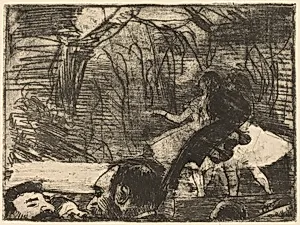
Step into the luminous world of Edgar Degas *On Stage I* (1876), a print that captures the grace and drama of the ballet. Degas, a master of the Impressionist movement was obsessed with the theater, particularly the Paris Opéra Ballet. This intimate etching depicts performers mid-performance, freezing a moment of poised elegance amid the spotlight's glow. Created during a pivotal year when Degas was experimenting with printmaking to explore movement and light, it reflects his innovative approach to everyday scenes infused with artistic fervor. The work employs soft-ground etching and drypoint on wove paper, techniques that allowed Degas to achieve delicate, textured lines resembling spontaneous sketches. Soft-ground etching captures soft, painterly effects, while drypoint's burr produces rich, velvety tones—perfect for conveying the ballerinas' flowing costumes and dynamic postures. At just 12 × 16.2 cm, the plate size invites close viewing, emphasizing Degas's fascination with the backstage and onstage lives of dancers as modern muses. Housed in the National Gallery of Art's Rosenwald Collection, *On Stage I* exemplifies Degas's printmaking legacy, bridging painting and graphics. It offers visitors a window into 19th-century Parisian culture, where ballet symbolized both beauty and labor, reminding us of art's power to elevate the ephemeral.
About the Artist
Edgar Degas · 1834–1917
Edgar Degas (1834-1917) stands as one of the most innovative artists of the nineteenth century, whose distinctive vision transformed how modern life could be depicted on canvas. Born Hilaire-Germain-Edgar De Gas in Paris to a wealthy banking family—his father French, his mother a Louisiana Creole from New Orleans—Degas received a classical education before abandoning law studies in 1855 to pursue ...