
Thunder (Un coup de foudre)
1826 to 1850
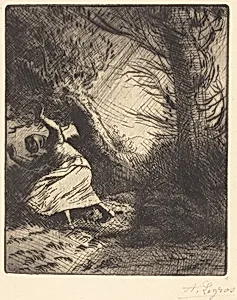
Medium
etching and drypoint?
Classification
Department
CG-E
Museum
National Gallery of Art, Washington, D.C.
Credit
Gift of George Matthew Adams in memory of his mother, Lydia Havens Adams
Accession Number
1946.4.21
Rights
Public Domain
Art Historical Context
Behold *Thunder (Un coup de f)*, a captivating print by French-born artist Alphonse Legros (1837–1911), created between 1826 and 1850. This etching and drypoint work, housed in the National Gallery of's Department CG-E, evokes the raw power of nature through its dramatic title—*Un coup de foudre* meaning "bolt of lightning" in French. Legros, a master printmaker who bridged French Realism and British art circles, drew inspiration from 17th-century masters like Rembrandt, infusing his scenes with emotional depth and atmospheric intensity. The medium shines here: etching creates precise, fluid lines via acid-etched plates, while drypoint adds velvety burrs from direct needle scratches, yielding rich textures ideal for stormy skies and shadowy forms. This 19th-century etching revival technique allowed Legros to capture fleeting natural drama affordably, making fine art accessible beyond paintings. As a print, it exemplifies how such works democratized artistry during the Romantic era's fascination with sublime landscapes. Generously gifted by George Matthew Adams in memory of his mother, Lydia Havens Adams, this piece invites visitors to ponder nature's fury—and perhaps a spark of sudden passion—in Legros's skilled hand. A testament to printmaking's enduring allure!
About the Artist
Alphonse Legros · 1837–1911
Alphonse Legros (1837–1911) was born in Dijon, France, and trained in Paris at the drawing school of Horace Lecoq de Boisbaudran, whose unconventional teaching method — which emphasised memory drawing and acute observation over academic convention — would leave a lasting mark on Legros's practice. At Lecoq's school he formed friendships with Jules Dalou and Auguste Rodin that endured throughout hi...