
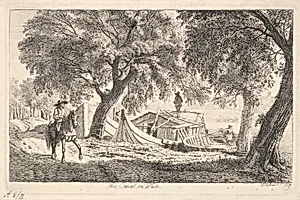
On the Canal in Vienna
Medium
Etching; second state
Dimensions
plate: 4 1/2 x 6 3/4 in. sheet: 4 3/4 x 7 1/8 in.
Classification
Prints
Department
Drawings and Prints
Museum
Metropolitan Museum of Art, New York, NY
Credit
Gift of J. B. Neumann, 1960
Accession Number
60.681.40
Rights
Public Domain
Tags
Art Historical Context
Johann Christoph Erhard's *On the Canal in Vienna (1819) is a delicate etching capturing a serene moment along one of Vienna's waterways, likely the Danube Canal. The second-state impression, measuring a modest 4½ x 6¾ inches on the plate, depicts men, horses, and trees in a harmonious urban landscape. This intimate print evokes the everyday rhythm of early 19th Vienna, a city thriving in the post-Napoleoniciedermeier era, artists turned to precise, nostalgic views of local life amid political stability and cultural refinement. Erhard (1795–1862), a German engraver who worked extensively in Vienna and Munich, excelled in topographical etchings that blend Romantic sensitivity with technical precision. Etching, his favored medium, allowed him to incise fine lines into a copper plate with acid, yielding intricate textures—from the rippling water to the foliage and figures—that convey depth and atmosphere in small-scale works. The second state suggests refinements to the plate, enhancing contrast and detail for later printings. Housed in the Metropolitan Museum of Art's Drawings and Prints department (gift of J. B. Neumann, 1960), this piece offers a window into Vienna's canals as bustling yet picturesque veins of the city, reminding us how prints democratized art, making such evocative scenes accessible to collectors and the curious public alike.
About the Artist
Johann Christoph Erhard · 1795–1822
Johann Christoph Erhard (1795–1822) was a German painter and etcher of the Romantic era whose sensitive landscape studies and skillful prints earned him a growing reputation before his tragically early death at twenty-six. Born in Nuremberg, he studied at the Nuremberg Academy and later in Munich, where he was influenced by the Romantic landscape tradition and the revival of interest in the art of...