
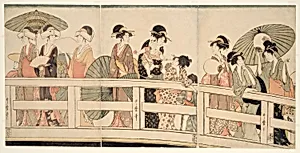
On top and beneath Ryogoku Bridge (Ryogokubashi no ue, shita)
c. 1795/96
Medium
Color woodblock print; oban hexaptych (one of a pair of triptychs)
Dimensions
Right sheet: 38.4 × 25.4 cm (15 1/8 × 10 in.); Center sheet: 38.4 × 25 cm (15 1/8 × 9 7/8 in.); Left sheet: 38.2 × 25.2 cm (15 1/16 × 9 15/16 in.); All three sheets: 38 × 76.6 cm (15 × 30 3/16 in.)
Classification
woodblock print
Department
Arts of Asia
Museum
Art Institute of Chicago
Accession Number
8182
Rights
Public Domain
Art Historical Context
Kitagawa Utamaro's *On Top and Beneath Ryogoku Bridge (ogokubashi no ue, shita)*, around 1795–96, is a stunning color woodblock print from Japan's Edo period. This oban hexaptych—one a pair of tripts—comprises three large sheets that together form a panoramic vista spanning about 38 × 76.6 cm. Ryogoku Bridge, a landmark over the Sumida River in bustling Edo (modern Tokyo), served as a vibrant hub for festivals, sumo wrestling, and everyday revelry, making it a perfect subject for ukiyo-e, the "pictures of the floating world" genre celebrating urban pleasures. Utamaro, a master of bijin-ga (images of beautiful women), showcases his genius for delicate lines, subtle gradations, and vivid colors achieved through the intricate woodblock process—multiple carved blocks inked in layers for rich hues. The composition ingeniously contrasts life above the bridge's lively crowds with scenes below, perhaps along the riverbanks, capturing the dynamic energy of 18th-century Japanese society. Such large-scale prints were innovative, allowing immersive storytelling on a grand scale. Housed in the Art Institute of Chicago's Arts of Asia department, this work highlights ukiyo-e's cultural role in democratizing art via affordable prints, influencing global modernism from Whistler to Van Gogh. A window into Edo's joie de vivre!
About the Artist
Kitagawa Utamaro · 1753–1806
Kitagawa Utamaro (c. 1753-1806) was one of the most celebrated masters of ukiyo-e woodblock printing, revolutionizing the art of bijin-ga (pictures of beautiful women) during Japan's Edo period. Born Kitagawa Ichitaro, his early life remains shrouded in mystery, with conflicting accounts placing his birth in Kyoto, Osaka, Yoshiwara in Edo (modern Tokyo), or Kawagoe in Musashi Province. Under the t...