
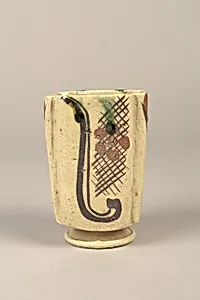
One from set of five squared food vessels (mukōzuke) for tea-gathering meal
Unknown Artist
early 17th century
Medium
Stoneware with iron-oxide and copper green overglaze decoration (Mino ware, Yashichida Oribe type)
Dimensions
H. 3 5/8 in. (9.2 cm); W. 2 3/4 in. (7 cm)
Classification
Ceramics
Culture & Period
Japan · Momoyama (1573–1615) or Edo (1615–1868) period
Department
Asian Art
Museum
Metropolitan Museum of Art, New York, NY
Credit
Purchase, Mary Livingston Griggs and Mary Griggs Burke Foundation Gift, 1973
Accession Number
1973.80.2
Rights
Public Domain
Art Historical Context
This delicate squared food vessel, known as a *mukōzuke*, is one of a set of five designed for serving side dishes during intimate tea-gathering meals in early 17th-century Japan Part of the Momoyama (3–1615) or early Edo (1615–1868) period, it the refined aesthetics of the Japanese tea ceremony (*chanoyu*), where humble, irregular forms embodied *wabi-sabi*—the beauty of imperfection and transience. These small vessels (just 3⅝ inches high and 2¾ inches wide) encouraged mindful appreciation of food alongside matcha tea, fostering social harmony among samurai, merchants, and tea masters. Crafted in Mino ware's Yashichida Oribe type, the stoneware features vibrant overglaze decoration with iron-oxide for earthy reds and copper green for lustrous turquoise hues. Oribe style, named after tea master Furuta Oribe, revolutionized ceramics with its bold, asymmetrical patterns and glossy finishes, fired at high temperatures in kilns near Nagoya. This technique allowed durable yet artistic pieces that transitioned from elite tea rooms to everyday use, marking Japan's ceramic golden age. Today, at the Metropolitan Museum of Art, this vessel highlights how Mino potters democratized luxury, blending functionality with artistic flair in a pivotal era of cultural refinement.