
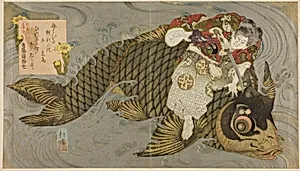
Oniwakamaru subduing the giant carp
c. 1830/35
Medium
Color woodblock print; shikishiban diptych, surimono
Dimensions
21 × 36.9 cm (8 1/4 × 14 1/2 in.)
Classification
woodblock print
Department
Arts of Asia
Museum
Art Institute of Chicago
Accession Number
24889
Rights
Public Domain
Art Historical Context
Step into the vibrant world of Edo-period Japan with *Oniwakamaru Subduing the Giant Carp a captivating color woodblock print by Totoya Hokkei (1780–1850), created around 1830–35. This shikishiban diptych—a pair of square-format sheets forming a single image—depicts the legendary hero Oniwakamaru, a youthful warrior from Japanese folklore inspired by the historical figure Watanabe no Tsuna. Here, he triumphs over a massive, thrashing carp in a dynamic scene blending myth and heroism, showcasing the era's fascination with kabuki theater and supernatural tales. As a *surimono*, this print was a luxurious, privately commissioned work, often produced for poetry societies or New Year's greetings. Hokkei, a skilled pupil of the master Katsushika Hokusai, employed exquisite ukiyo-e techniques: intricate carving for bold colors, subtle gradations (*bokashi*), and possibly mica dusting or embossing for a shimmering, tactile effect. Measuring just 21 × 36.9 cm, its intimate scale invited close admiration, highlighting the artistry of woodblock printing during Japan's floating world (*ukiyo*) culture. Housed in the Art Institute of Chicago's Arts of Asia collection, this piece exemplifies surimono's cultural prestige—rarer and finer than commercial prints—offering a window into 19th-century Japan's blend of artistry, literature, and folklore. Marvel at how Hokkei's precise lines capture the carp's scales and Oniwakamaru's determination, a testament to the enduring allure of these ephemeral treasures.
About the Artist
Totoya Hokkei · 1780–1850
Totoya Hokkei (魚屋 北渓, 1780–1850), born Iwakubo Tatsuyuki in Edo (modern Tokyo), began his life as a humble fishmonger in the Yotsuya Samegahashi district, a trade reflected in his art name "Totoya," meaning fish shop. He transitioned to art through rigorous training, first studying under Kanō Yōsen'in Korenobu, head of the Kobikichō branch of the prestigious Kanō school, where he honed landscape p...