
Onthoofding van Johannes de Doper
1490 - 1552
Medium
etching
Dimensions
165; 248
Rights
Public Domain
About this artwork
ets
Art Historical Context
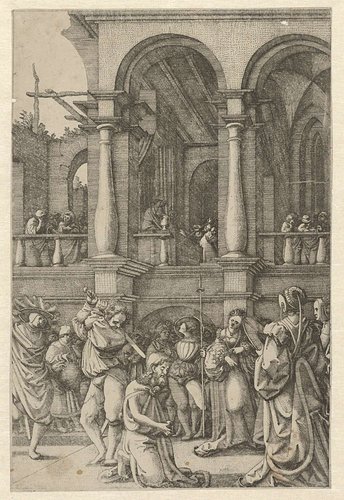
**Onthoofding van Johannes Doper (The Beheading of John the)** *Frans Crabbe van Esghem, ca. 1490–1552, etching, 248 × 165 mm* This etching by Flemish artist Frans Crabbe Espleghem depicts dramatic biblical scene of the beheading of John the Baptist a pivotal moment from the New Testament recounted in the Gospels. Crabbe, a master printmaker from Mechelen in the Netherlands, captured the tension of Herod's feast and Salome's fateful request with intricate detail, reflecting the religious fervor of the Northern Renaissance. Produced during the early 16th century, the work embodies the era's devotion to moral and spiritual narratives, making it a window into late medieval piety. Etching, Crabbe's favored medium, marked a revolutionary technique at the time—using acid to bite lines into a metal plate for a freer, more spontaneous line quality than traditional engraving. This small-scale print (just under 10 by 6.5 inches) allowed for widespread dissemination of sacred stories to the faithful, who could afford affordable reproductions. Crabbe's style, influenced by contemporaries like Lucas van Leyden, features fine hatching and cross-hatching to evoke depth, shadow, and emotion in the executioner's grim act. As a cultural artifact, this piece highlights the Flemish tradition of virtuoso printmaking, bridging Gothic detail with emerging Renaissance naturalism. Visitors will appreciate its technical precision and haunting intensity, a testament to how art conveyed faith in turbulent times.
About the Artist
Frans Crabbe van Espleghem · 1480–1553
Frans Crabbe van Espleghem was one of the leading artists in Mechelen, the capital of the southern Netherlands. He began his career painting altarpieces but after Albrecht Dürer's visit to the Netherlands in 1521, Crabbe began to produce prints. He combined Italianate figure types with a concern for atmosphere and depth in landscape and an emphasis on ordinary daily life and humble people. In 1539...