
De Passie
1455 - 1503
Medium
engraving
Dimensions
142; 203
Rights
Public Domain
About this artwork
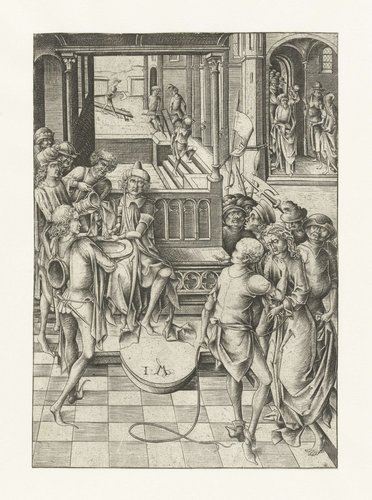
Christus staat, de doornenkroon op het hoofd en omringd door gewapende mannen, voor een man op een troon (Pilatus). Deze wast zijn handen in een schotel. Links op de achtergrond zijn timmerlui bezig het kruis te maken, rechts brengt Judas de zilverlingen terug. Deze prent is onderdeel van een serie van twaalf prenten met scènes uit het Lijdensverhaal.
Art Historical Context
**De Passie (The Passion)** by Israhel van Meckenem (ca. 1455–1503) captures a pivotal moment from the biblical Passion of Christ in intricate engraving. Christ, wearing the crown of thorns and encircled by armed soldiers, before Pontius Pilate seated on a throne, ritually washing his hands to disclaim responsibility. In the background, carpenters fashion the cross on the left, while Judas returns his thirty pieces of silver on the right, weaving a rich narrative tapestry of betrayal, judgment, and impending sacrifice. Measuring 203 × 142 mm, this print exemplifies the late 15th-century Northern European mastery of engraving, a technique that allowed artists like van Meckenem—a prolific German printmaker—to produce detailed, reproducible images for a growing audience of devout collectors. As part of a series of twelve engravings devoted to the Lijdenverhaal (Passion narrative), *De Passie* reflects the era's intense focus on Christ's suffering, fueling personal devotion during the late Gothic period amid rising literacy and piety. Van Meckenem's fine lines and crowded compositions draw viewers into the drama, blending religious instruction with artistic virtuosity. These affordable prints democratized sacred art, bringing vivid scenes of redemption into homes across Europe and underscoring engraving's revolutionary role in visual storytelling.
About the Artist
Israhel van Meckenem · 1435–1503
Israhel van Meckenem (c. 1445–1503), also known as Israhel van Meckenem the Younger, was a pioneering German engraver and goldsmith based in Bocholt, near the Dutch border, renowned as the most prolific printmaker of the fifteenth century. Born into a family possibly of Dutch origin, he was the son of Israhel van Meckenem the Elder, a goldsmith who settled in Bocholt in 1457. He trained initially ...