
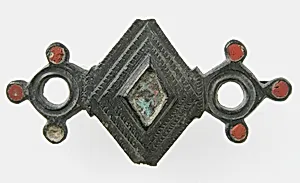
Openwork Brooch
Unknown Artist
3rd century
Medium
Champlevé enamel, copper alloy
Dimensions
Overall: 1 15/16 x 7/8 x 1/2 in. (4.9 x 2.3 x 1.2 cm)
Classification
Enamels-Champlevé
Culture
Roman
Department
Medieval Art
Museum
Metropolitan Museum of Art, New York, NY
Credit
Gift of J. Pierpont Morgan, 1917
Accession Number
17.192.11
Rights
Public Domain
Art Historical Context
This delicate **Openwork Brooch**, in the 3rd century during the late Roman Empire, exemplifies the jewelry of ancient Rome. Measuring just under 2 inches across, this small copper alloy piece was likely used to fasten cloaks or garments, blending functionality with artistry. Its openwork design—featuring pierced motifs that allow light to shimmer through—creates a sense of movement and elegance, perfect for personal adornment in daily or ceremonial life. The brooch's standout feature is its **champlevé enamel technique**, an innovative method where troughs are carved into the metal base, filled with powdered glass enamel, and fired to fuse vibrant colors. This Roman-era enamelwork, classified among early enamels, highlights advanced metalworking skills and a love for luminous, jewel-like effects. Such techniques bridged classical antiquity and later medieval traditions, influencing Byzantine and European jewelry. A generous gift from J. Pierpont Morgan in 1917, this treasure now resides in The Metropolitan Museum of Art's Medieval Art Department, underscoring its role in the evolution from Roman to early medieval aesthetics. Visitors will appreciate its tiny scale, which reveals the precision of ancient artisans up close.