
S-Shaped Brooch
Unknown Artist
6th century
Medium
Silver-cast relief and settings; chased, punched; garnets, gilt; iron pin.
Dimensions
Overall: 1 9/16 x 1 1/16 x 3/8 in. (4 x 2.7 x 0.9 cm)
Classification
Metalwork-Silver
Culture
Frankish
Department
Medieval Art
Museum
Metropolitan Museum of Art, New York, NY
Credit
Gift of J. Pierpont Morgan, 1917
Accession Number
17.192.1
Rights
Public Domain
Art Historical Context
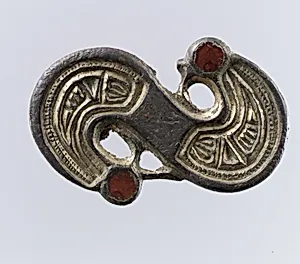
This exquisite S-Shaped Brooch crafted by an unknown Frankish artisan in the 6th, exemplifies the masterful metalwork of early medieval Europe. Hailing from the Merovingian period—when the Franks ruled much of post-Roman Gaul—this small jewelry piece (just 1 9/16 x 1 1/16 inches) was likely used to fasten cloaks or garments, serving both practical and prestigious functions. Its sinuous S-form echoes designs popular among Germanic tribes during the Migration Period, blending functionality with elegant ornamentation. The brooch's construction highlights sophisticated techniques: cast silver relief forms the base, adorned with chased and punched decorations that create intricate patterns through hammering and tooling. Vibrant garnets are set into the silver, their deep red hue enhanced by gilding for a luxurious glow, while a sturdy iron pin ensures durability. Garnets were prized in this era for their rarity and symbolic power, often linked to wealth and status among Frankish elites. Housed in the Metropolitan Museum of Art's Medieval Art department (gift of J. Pierpont Morgan, 1917), this brooch offers a tangible glimpse into Frankish daily life and artistry, revealing how everyday objects became canvases for cultural expression amid Europe's transformative early Middle Ages.