
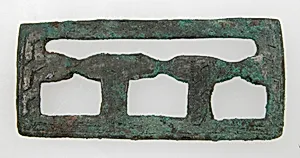
Openwork Plaque
Unknown Artist
middle of 6th century
Medium
Copper alloy, "tinned" surface
Dimensions
Overall: 2 3/16 x 15/16 x 1/16 in. (5.5 x 2.4 x 0.2 cm)
Classification
Metalwork-Copper alloy
Culture
Frankish
Department
Medieval Art
Museum
Metropolitan Museum of Art, New York, NY
Credit
Gift of J. Pierpont Morgan, 1917
Accession Number
17.191.259
Rights
Public Domain
Art Historical Context
This delicate Openwork Plaque, crafted by an unknown Frankish artist in mid-6th century, exemplifies the metalworking skills of the early Merovingian period. Measuring just over 2 inches long and remarkably thin at 1/16 inch, it was fashioned from copper alloy with a "tinned" surface—a where a thin layer of tin was applied to mimic the gleam of silver, making fine jewelry and ornaments accessible beyond elite goldsmiths. The openwork design, featuring intricate cutouts, allowed light to play through its patterns, enhancing its visual appeal in everyday or ceremonial use. Hailing from the Frankish culture that dominated post-Roman Gaul (modern France and Germany), this plaque likely adorned a belt buckle, horse harness, or personal accessory, reflecting the era's blend of Roman technical legacies and emerging Germanic motifs. Such artifacts highlight the Merovingians' mastery of repoussé and piercing techniques, where metal was hammered and pierced to create airy, lace-like effects. Its survival speaks to the durability of these small-scale treasures amid turbulent times of kingdom-building under rulers like Clovis and his successors. Today, this piece graces the Medieval Art department at The Metropolitan Museum of Art, a generous 1917 gift from J. Pierpont Morgan. It invites visitors to marvel at how 1,400-year-old craftsmanship bridges antiquity and the Middle Ages, offering a tangible glimpse into Frankish daily life and artistry.