
Ferret
Unknown Artist
6th–7th century
Medium
Copper alloy, silvered
Dimensions
Overall: 1 13/16 x 1/2 x 3/16 in. (4.6 x 1.3 x 0.4 cm)
Classification
Metalwork-Copper alloy
Culture
Frankish
Department
Medieval Art
Museum
Metropolitan Museum of Art, New York, NY
Credit
Gift of J. Pierpont Morgan, 1917
Accession Number
17.191.228
Rights
Public Domain
Art Historical Context
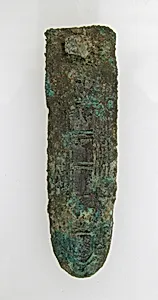
Nestled in the Metropolitan Museum of Art's Medieval collection, this diminutive "Ferret" figurine, crafted by an unknown Frankish artist in the 6th–7th, exemplifies the exquisite metalwork of the Meroving period. Measuring just 1 13/16 x 1/2 x 3/16 inches, the copper alloy piece was enhanced with silvering—a technique that applied a thin silver layer to mimic more precious metals, lending it a luxurious sheen despite its modest material. Likely a decorative mount or ornament, its lifelike form captures the agile ferret, a creature symbolizing cunning and hunting prowess in early medieval lore. Frankish artisans, thriving in what is now France and Germany under the Merovingian dynasty, were renowned for such intricate small-scale works, often adorning personal items like belts, harnesses, or reliquaries. This ferret reflects their mastery of casting and chasing techniques, where fine details were hammered or incised into the metal for texture and vitality. Gifted to the Met in 1917 by J. Pierpont Morgan, it offers a window into daily life and elite craftsmanship of post-Roman Europe, bridging pagan animal motifs with emerging Christian influences. Though tiny, its survival speaks to the durability of Frankish metalwork and the cultural value placed on naturalistic animal representations, evoking a world where art intertwined with utility and symbolism.