
Openwork Rosette Brooch
Unknown Artist
6th century
Medium
Silver, silver-gilt, garnet, iron
Dimensions
Overall: 7/8 x 1/4 in. (2.2 x 0.7 cm)
Classification
Metalwork-Silver
Culture
Frankish
Department
Medieval Art
Museum
Metropolitan Museum of Art, New York, NY
Credit
Gift of J. Pierpont Morgan, 1917
Accession Number
17.191.25
Rights
Public Domain
Art Historical Context
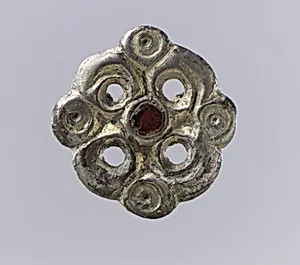
This delicate **Openwork Rosette Bro**, crafted by an unknown Frankish artisan in the 6th century, exemplifies the exquisite metalwork of early medieval Europe. Measuring just 78 x 1/4 inches (2.2 x 0.7 cm), this jewel features a floral rosette design pierced through silver sheets, adorned with silver-gilt accents and vibrant garnet inlays, with iron possibly used in its pin mechanism. Such openwork techniques allowed light to play through the intricate cutouts, creating a shimmering effect that highlighted its wearer's status. Hailing from the Frankish culture—associated with the Merovingian dynasty that dominated Gaul (modern France) after the fall of Rome—this brooch reflects the fusion of Roman craftsmanship and Germanic motifs. Garnets, sourced from distant trade routes like India or Bohemia, were prized for their rich red hue, symbolizing wealth and power among elites. Brooches like this fastened cloaks or dresses, serving both practical and ornamental roles in daily life. A gift to the Metropolitan Museum of Art from J. Pierpont Morgan in 1917, this piece offers a window into the artistry of a transformative era, bridging antiquity and the Middle Ages. Visitors will appreciate its precision, a testament to skilled hands in an age of upheaval.