
Whorl-Shaped Brooch
Unknown Artist
ca. 550–650
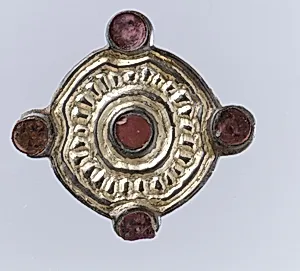
Medium
Silver-gilt, glass paste, remnant of iron pin
Dimensions
Overall: 1 1/4 x 3/8 in. (3.1 x 1 cm)
Classification
Metalwork-Silver
Culture
Frankish
Department
Medieval Art
Museum
Metropolitan Museum of Art, New York, NY
Credit
Gift of J. Pierpont Morgan, 1917
Accession Number
17.191.197
Rights
Public Domain
Art Historical Context
This delicate whorl-shaped brooch, crafted around 550–650 CE by an unknown Frankish artisan, exemplifies the exquisite metalwork of early medieval Europe. Measuring just 1¼ x ⅜ inches, it was fashioned from silver-gilt—a silver base coated with a thin layer of gold for a luxurious sheen—adorned with colorful glass paste insets mimicking precious gems, and fitted with a remnant of an iron pin for fastening garments. Such intricate designs highlight the technical prowess of Frankish jewelers during the Merovingian period, blending functionality with ornamental flair. Frankish culture, rooted in the Germanic tribes who dominated post-Roman Gaul, produced these brooches as status symbols worn by both men and women to secure cloaks or cloaks. The whorl shape, evoking spinning whorls or celestial motifs, reflects influences from Migration Period artistry, where spirals symbolized continuity and motion. This piece, now in the Metropolitan Museum of Art's Medieval Art department thanks to a 1917 gift from J. Pierpont Morgan, offers a tangible glimpse into daily life and elite fashion among the Franks, whose kingdom laid the foundations for medieval France and Germany. Its survival underscores the enduring appeal of these small treasures, bridging the classical world and the Middle Ages through masterful gilding techniques and vibrant materials.